Tuesday, 7 February 2017

Hellelil and Hildebrand ~ Frederic William Burton

Frederic William Burton
Hellelil and Hildebrand, The Meeting on the Turret Stairs
This richly coloured watercolour painting depicts the ill-fated lovers Hellelil and Hildebrand, meeting on the stone stairway of a medieval tower. The princess and her bodyguard had fallen in love but her father regarded the young soldier as an unsuitable match for his daughter and ordered his sons to kill him. The painting captures the couple’s poignant final embrace.

Burton was inspired by the story of the ill-fated lovers told in an old Danish ballad. The poem had been translated into English in 1855 by Whitley Stokes, a lawyer and philologist, and friend of the artist.

This watercolour, painted by Burton when he was at the height of his career, has been popular since it was first exhibited at the Old Watercolour Society’s Annual exhibition in London in 1864. The writer George Eliot (who had her portrait painted by Burton in 1865) praised it saying: ‘the subject might have been made the most vulgar thing in the world – the artist has raised it to the highest pitch of refined emotion’ and went on to focus on the romance in the picture: ‘the face of the knight is the face of a man to whom the kiss is a sacrament.’

The Meeting on the Turret Stairs is a very important work in Burton’s oeuvre, he made numerous preparatory studies for it, four of which are in the National Gallery of Ireland’s collection. Burton sold the painting to a dealer, Edward Fox White in 1864 but the contract they signed notes that Burton retained the copyright, presumably aware of how valuable the image would be as a print. The painting changed hands a number of times over the following 30 years but in 1898 it was bought by Miss Margaret McNair Stokes (sister of Whitley Stokes). An article by Jeanette Stokes in the Irish Arts Review, (Vol.26, no.3, 2009) refers to the fact that there are tantalising hints in some of Margaret Stokes’s letters to her family that her interest in Burton was something more than friendship. Margaret Stokes was writing a biography of Burton when she died in 1900, in her will she bequeathed the painting, along with a number of other works by Burton, to the National Gallery of Ireland.
"Hildebrand and Hellelil. Translated from the Danish" from Poems by the Way (1891)

Hellelil sitteth in bower there,
None knows my grief but God alone,
And seweth at the seam so fair,
I never wail my sorrow to any other one.

But there whereas the gold should be
With silk upon the cloth sewed she.

Where she should sew with silken thread
The gold upon the cloth she laid.

So to the Queen the word came in
That Hellelil wild work doth win.

Then did the Queen do furs on her
And went to Hellelil the fair.

"O swiftly sewest thou, Hellelil,
Yet nought but mad is thy sewing still!"

"Well may my sewing be but mad
Such evil hap as I have had.

My father was good king and lord,
Knights fifteen served before his board.

He taught me sewing royally,
Twelve knights had watch and ward of me.

Well served eleven day by day,
To folly the twelfth did me bewray.

And this same was hight Hildebrand,
The King's son of the English Land.

But in bower were we no sooner laid
Than the truth thereof to my father was said.

Then loud he cried o'er garth and hall:
'Stand up, my men, and arm ye all!

'Yea draw on mail and dally not,
Hard neck lord Hildebrand hath got!'

They stood by the door with glaive and spear;
'Hildebrand rise and hasten here!'

Lord Hildebrand stroked my white white cheek:
'O love, forbear my name to speak.

'Yea even if my blood thou see,
Name me not, lest my death thou be.'

Out from the door lord Hildebrand leapt,
And round about his good sword swept.

The first of all that he slew there
Were my seven brethren with golden hair.

Then before him stood the youngest one,
And dear he was in the days agone.

Then I cried out: 'O Hildebrand,
In the name of God now stay thine hand.

'O let my youngest brother live
Tidings hereof to my mother to give!'

No sooner was the word gone forth
Than with eight wounds fell my love to earth.

My brother took me by the golden hair,
And bound me to the saddle there.

There met me then no littlest root,
But it tore off somewhat of my foot.

No littlest brake the wild-wood bore,
But somewhat from my legs it tore.

No deepest dam we came unto
But my brother's horse he swam it through.

But when to the castle gate we came,
There stood my mother in sorrow and shame.

My brother let raise a tower high,
Bestrewn with sharp thorns inwardly.

He took me in my silk shirt bare
And cast me into that tower there.

And wheresoe'er my legs I laid
Torment of the thorns I had.

Wheresoe'er on feet I stood
The prickles sharp drew forth my blood.

My youngest brother me would slay
But my mother would have me sold away.

A great new bell my price did buy
In Mary's Church to hang on high.

But the first stroke that ever it strake
My mother's heart asunder brake."

So soon as her sorrow and woe was said,
None knows my grief but God alone,
In the arm of the Queen she sat there dead,
I never tell my sorrow to any other one.
Love and light,
Trace
xoxo

Yvain, the Knight of the Lion: An interview with Yvain ~ Chrétien de Troyes

A wonderful fictitious interview ~ Yvain, the Knight of the Lion (French: Yvain ou le Chevalier au Lion) is an Arthurian romance by French poet Chrétien de Troyes. It was probably written in the 1170s simultaneously with Lancelot, the Knight of the Cart, and includes several references to the narrative of that poem.
It is a story of knight-errantry, in which the protagonist Yvain is first rejected by his lady for breaking a promise, and subsequently, performs a number of heroic deeds in order to regain her favour.
~ Good morning Yvain. What drove you into the adventure of the fountain that your cousin Calogrenant had made?

"I went to the fountain to save the honour of my cousin, who had been defeated by a knight."

"Can you describe the fountain?"

The fountain was made of emeralds, and to support the emerald there were four flaming rubies.
Lady of the Fountain

"Can you tell us what happened at the castle?"

- When I was locked up in the castle a young girl came to bring me a ring so that nobody could see me. Everybody was searching and searching everywhere for the assassin of their lord. After this bustle, I could hear shrieks and tears. I looked at my window and saw a lovely woman with long hair and a beautiful coat. I was in love. Then the girl at the ring returned and bathed me because I had not bathed for a long time. She gave me fine clothes. A few days later she told me to follow her without being seen, and we went into the room of Dame Laudine, the old wife of the lord whom I conquered. It was the Lady I had seen and loved. We made peace and we got married.
- Who told you to leave your wife and why?

- This is Gawain who told me to leave my wife because I had to keep my reputation by tournaments and battles.

- What was your "delay" to return to the castle after your adventures and why did you break it?

- My wife had me set a "deadline" for a year. I broke it because I did not know how many days had passed since I left. And after the delay, Lunette, the girl with the ring, came to warn me that beyond this time, my wife, Laudine, would have no more love for me.

- What happened?

- After I left the forest half crazy. I do not remember what happened, but I know I woke up naked with clothes on a chair and eat, then I put on those clothes and got out of where I was. I met a young woman who accompanied me to her chateau. Then the Count de l'Alier's troops arrived at the castle and I fought them. Then I left the castle.
Art by John Howe
"How was the meeting with the lion?"

- I was walking in the forest when suddenly I saw a lion fighting a snake spitting fire. I had to save one of the two animals. I chose the lion because it was a courageous and valiant animal. With my sword, I cut the snake into pieces to deliver the lion to whom it had burned the beginning of the tail. I had to cut a part of his tail because the head of the snake was hung on this one. Afterwards, I expected to fight also with the lion that would surely devour me. Instead, the lion went to my feet as a sign of gratitude. Then I left and he followed me. We spent the night together and from that moment I knew he would never leave me, that I was his master.
Art by Natalia Golovanova
- What happened when you met Lunette? Where was she and why?

- I continued my way when I heard "Help!" In a voice I recognised. It was Lunette. She was a prisoner because my wife had no more confidence in her, and so that she would not be put to death she must have a chief who would compete for her. So I devoted myself because Lunette had once saved me from death.

"What knight did you beat after leaving Lunette?"

- After leaving Lunette, I went to a castle where I was very well received, but I felt a heavy atmosphere. The lord of the place needed a knight to face a barbaric man who lived in the mountains: Harpin de la Montagne. The latter retained his two sons and wanted his daughter as his wife. Harpin de la Montagne terrorised them because he had already defeated brave and brave knights. I accepted at once to help them, but only on one condition: that Harpin de la Montagne should not delay, for I had promised Lunette to be his knight to defend it.

"How many knights have you had to face to save Lunette, and who helped you in this battle?"

"To save Lunette, I had to face three knights. It was thanks to my lion that I defeated him.

- Owain, King Arthur he will come to reconcile the two sisters about inheritance?

- Not at first! And I had to fight like the other knight, I did not recognise at first. The combat was long and terrible, and we inflicted great wounds upon ourselves. After a break, during the fight, I realised that my opponent was my friend Gawain and that we could not continue. The king therefore, made the decision to settle the conflict by frightening the elder of the sisters by skilful words. She had no choice but to give inheritance to her younger brother.

- What did you do when you recovered from your injuries?

- I decided to reconquer my Lady, and I set off to trigger a terrible storm at the fountain. Laudine could not get out of it and asked Lunette for advice. She tells him she should appeal to the lion knight. As the lady did not know who was really that knight, she promised and made an oath to Lunette to do everything to reconcile her with her lady.

"Have you reconciled yourself with Laudine?"

- She was initially surprised to see me, and then as I apologised, and I recognised my faults and crimes, Dame Laudine forgave me. I was then the happiest of men.
Undine and Huldebrand by Henry Fuseli
Undine is a fairy-tale novella (Erzählung) by Friedrich de la Motte Fouqué in which Undine, a water spirit, marries a knight named Huldebrand in order to gain a soul.
Source HERE
Bryan Adams - (Everything I Do) I Do It For You
Excalibur (1981) Trailer
Love and light,
Trace
xoxo

Art Play ~ The Sun

Gesso base ~ watercolour pencils and crayons

Love and light,
Trace
xoxo

Unusual Flower ~ Diphylleia grayi

“Skeleton Flowers” become transparent when it rains.
The white skeleton flower is somewhat rare, growing in only three locations in the world: the cool, mountainside wetlands of Japan, China, and the Appalachian area of the US.
Diphylleia grayi is a flowering plant that is sometimes called Umbrella Leaf, but its other name, Skeleton Flower, is much more descriptive. When it rains, the otherwise pure white flowers of diphylleia grayi turn spectacularly translucent.
When not in bloom, the plant is quite plain.
As soon as the flowers dry out, they return to their normal white coloration.
Love and light,
Trace
xoxo

Sacred Grove ~ Gardens of Bomarzo ~ Italy

Magic Fantasy Music - The Ancient Gift
Photography by Bella Kotak

Gardens of Bomarzo
The Sacro Bosco ("Sacred Grove"), colloquially called Park of the Monsters (Parco dei Mostri in Italian), also named Garden of Bomarzo, is a Manieristic monumental complex located in Bomarzo, in the province of Viterbo, in northern Lazio, Italy. About an hour outside of Rome.
The garden was created during the 16th century. The garden is situated in a woods, located in a valley bottom, beneath the castle of Orsini, and populated by sculptures, and small buildings, located among the natural vegetation.
The park's name stems from the many larger-than-life sculptures, some sculpted in the bedrock, which populate this predominantly barren landscape. It is the work of Pier Francesco Orsini, called Vicino, a 16th-century condottiero, and patron of the arts, greatly devoted to his wife Giulia Farnese (not to be confused with her maternal grandmother Giulia Farnese, the mistress of Pope Alexander VI). When Orsini's wife died, he created the gardens to cope with his grief. The design is attributed to Pirro Ligorio, and the sculptures to Simone Moschino.
During the 19th century, and deep into the 20th, the garden became overgrown and neglected, but after the Spanish painter Salvador Dalí made a short movie about the park, and completed a painting actually based on the park in the 1950s, the Bettini family implemented a restoration program which lasted throughout the 1970s, and today the garden, which remains private property, is a major tourist attraction.
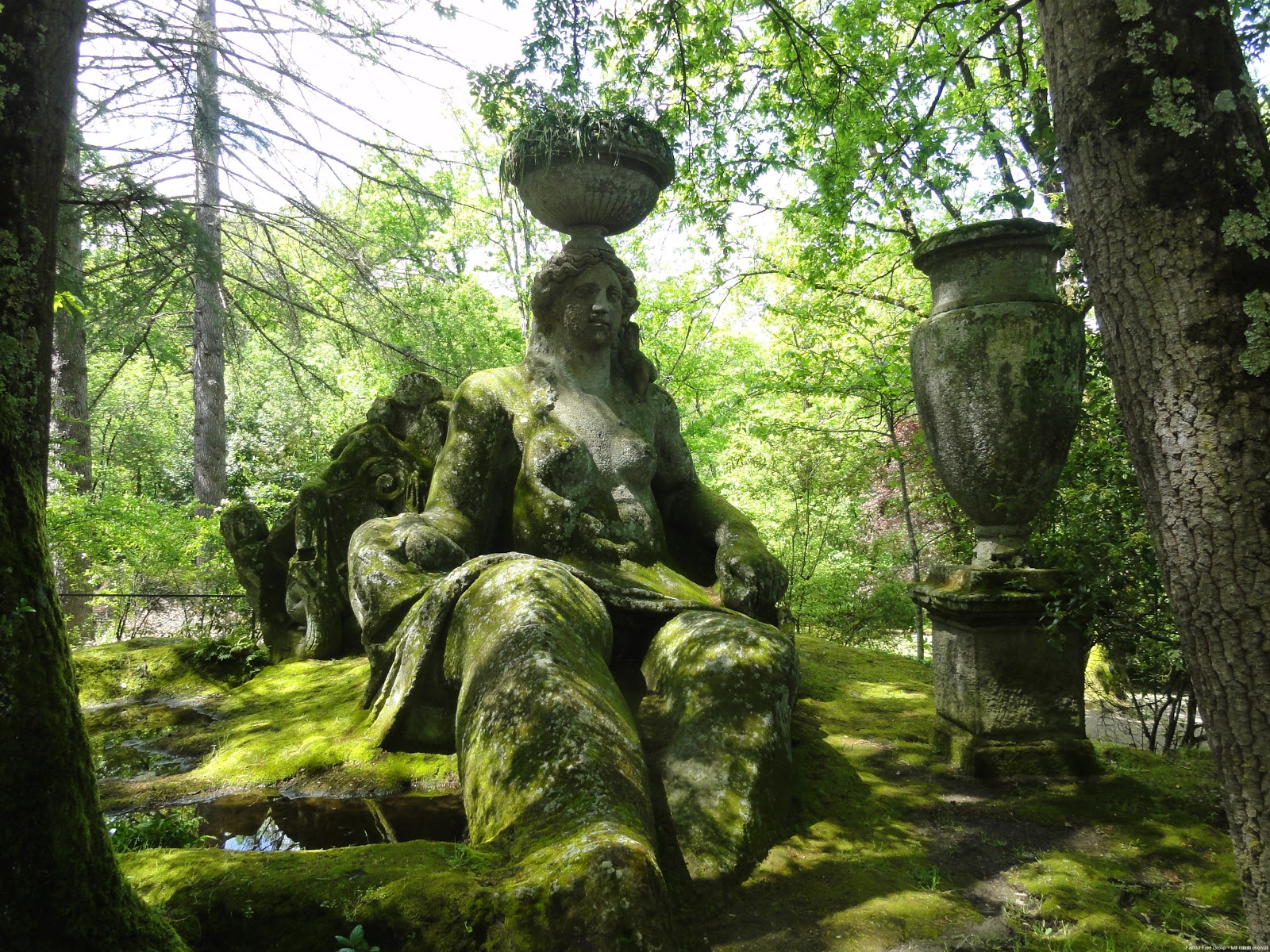
The park of Bomarzo was intended not to please, but to astonish, and like many Mannerist works of art, its symbolism is arcane: examples are a large sculpture of one of Hannibal's war elephants, which mangles a Roman legionary, or the statue of Ceres lounging on the bare ground, with a vase of verdure perched on her head.
The many monstrous statues appear to be unconnected to any rational plan, and appear to have been strewn almost randomly about the area, sol per sfogare il Core ("just to set the heart free") as one inscription in the obelisks says.
Allusive verses in Italian by Annibal Caro (the first one is of him, in 1564), Bitussi, and Cristoforo Madruzzo, some of them now eroded, were inscribed beside the sculptures.
The reason for the layout and design of the garden is largely unknown: perhaps they were meant as a foil to the perfect symmetry and layout of the great Renaissance gardens nearby at Villa Farnese, and Villa Lante. Next to a formal exit gate is a tilting watchtower-like casina, the so-called Casa Pendente ("Leaning House").

  • Niki de Saint Phalle was inspired by Bomarzo for her Tarot Garden, Giardino dei Tarocchi.
  • The story behind Bomarzo and the life of Pier Francesco Orsini are the subject of a novel by the Argentinian writer Manuel Mujica Láinez, Bomarzo (1962). Mujica Láinez himself wrote a libretto based on his novel, which was set to music by Alberto Ginastera (1967). The opera Bomarzo premièred in Washington in 1967, since the Argentine government had condemned it as sexually offensive.
  • A reimagined version of the garden is the centerpiece of the novel A Green and Ancient Light, written by Frederic S. Durbin.
Lazio comprises a land area of 17,236 km2 (6,655 sq mi) and it has borders with Tuscany, Umbria, and Marche to the north, Abruzzo and Molise to the east, Campania to the south, and the Tyrrhenian Sea to the west. Tyrrhenian Sea is named for the Tyrrhenian people, identified since the 6th century BCE with the Etruscans of Italy.Its name derives from the Greek name for the Etruscans, who were said to be emigrants from Lydia and led by the prince Tyrrhenus. The Etruscans settled along the coast of modern Tuscany and referred to the water as the "Sea of the Etruscans".
In Etruscan mythology, Tyrrhenus was one of the founders of the Etruscan League of twelve cities, along with his brother Tarchon. Herodotus describes him as the saviour of the Etruscans, because he led them from Lydia to Etruria. His name was given to the Etruscan people by the Greeks. The Romans extended this use to the sea west of Etruria: the Tyrrhenian Sea.
Etruscan religion and mythology were partly incorporated into classical Roman culture, including the Roman pantheon. The Senate adopted key elements of their religion, which were perpetuated by haruspices and noble Roman families who claimed Etruscan descent, long after the general population had forgotten the language. 
Echidna, The Lions And The Fury.

Long after the assimilation of the Etruscans, Seneca the Younger said that the difference between the Romans and the Etruscans was that

Whereas we believe lightning to be released as a result of the collision of clouds, they believe that the clouds collide so as to release lightning: for as they attribute all to deity, they are led to believe not that things have a meaning insofar as they occur, but rather that they occur because they must have a meaning.

More Here


Love and light,
Trace
xoxo

The Paper Unicorn ~ New Novel Inspiration

Elian and Felicity
 Elian Trevelyan ~ Felicity Campbell
💕
Work in progress
The Paper Unicorn ~ Fantasy Novel
Inspiration Journal
Quick scribbles of creative flow
Arty pages
Two characters come to life when Clara, a young woman from London, inherits an old manor house left to her by a stranger.

On moving in, her own life becomes entwined with that of a beautiful love story previously lost within the manor's stone walls.

Clara questions the intentions of the mysterious benefactor. Did the person know of the lovers? But more importantly, why was everything left to her? What is the connection between them?

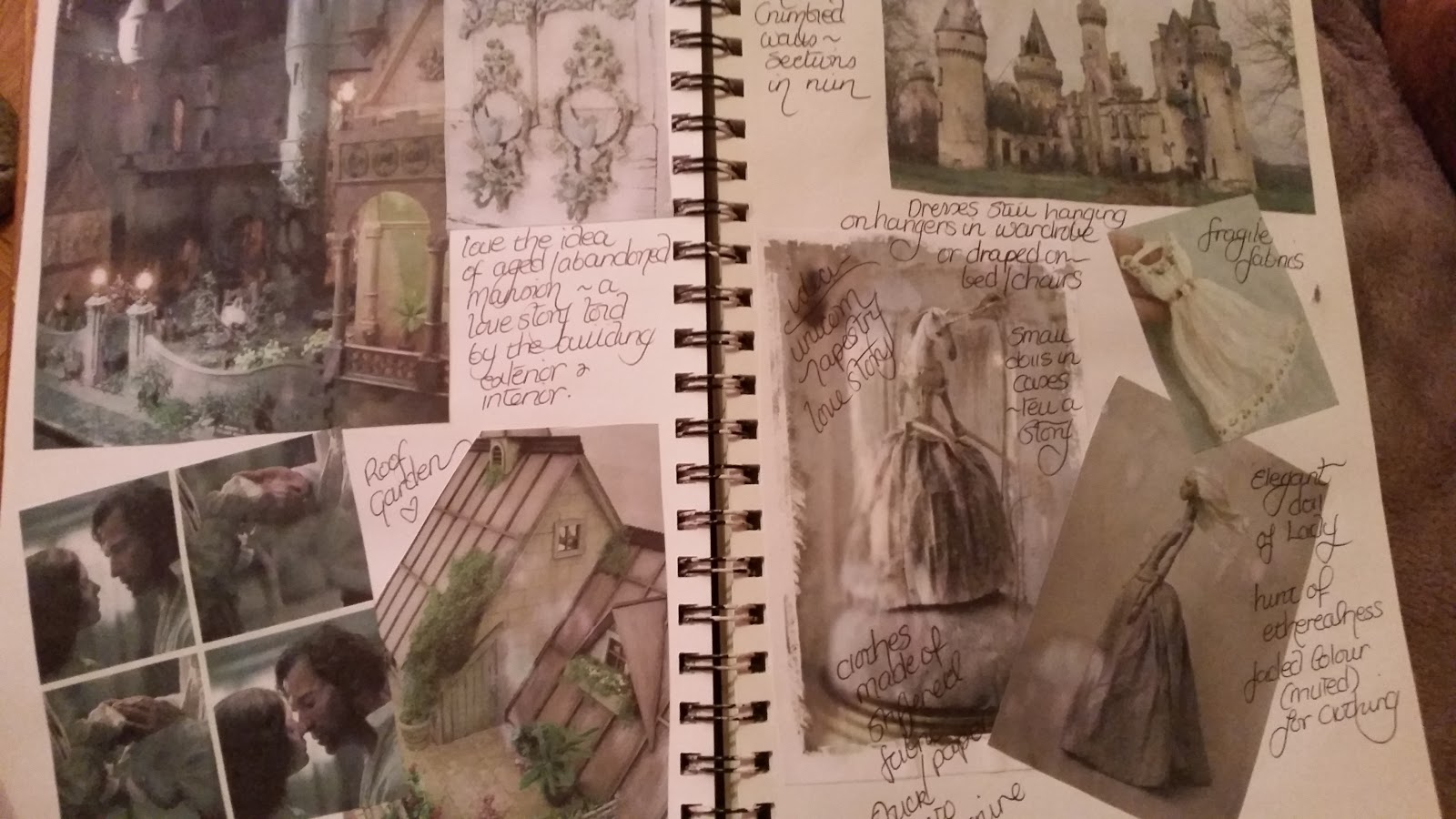
The story presented itself when I was creating a visual reference journal for a dolls house. The magic happens like that. Visuals and songs play through my mind and the new characters come alive. This story is quite different to 'A Carpet of Purple Flowers' but spiritual connections are still there. ;o) 
A romance that travels through time ~ the painting of characters
Music to tease the senses
Love and light,
Trace
xoxo

Monday, 6 February 2017

The Paper Unicorn ~ Novel

The Paper Unicorn
The Forgotten Manor 
Miss Felicity Campbell

A butterfly landed
Hearts seeking love ~ Minds independent and strong
The name is derived from an alteration of Aelianus (Latin), Elianus (Latin) or Helianus (Latin), which are ultimately of the Greek 'Helios'. 
A touch replaces words
Two people free of ancient boundaries
Can Clara make sense of the English Manor she inherited?

Love and light,
Trace
xoxo