Showing posts with label deer. Show all posts

Tuesday, 2 May 2017

Spirit Animals

Animals share with us the privilege of having a soul.  
~ Pythagoras
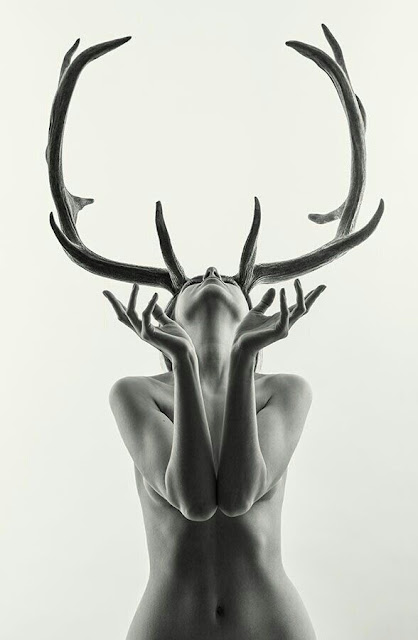
Deer Soul 
~ Art by Helga (A Gift 💜)
I've always been a deep thinker and this stems from my imaginative muse's thirst for knowledge. I question everything. Yes, I'm still 'that person' who continues to ask 'why?'. There's not a day which goes by without me thinking of 'the bigger picture' in some way, whether it's creatively related or on life. One of the areas that regularly interests me is the soul and the energy that connects everything. The more I research, certain elements repeatedly come up and usually connect in some way to something else, which I initially thought, was not related. Actually, this happens a lot, and I play with the idea that there is one source connecting all information. Like a massive, invisible library that we can tap into, to connect the dots, which are not normally within our reach. Much like the internet web, invisible, not able to view its entirety, but accessible through material technology. On the web, we tap into other people'ss feeds/posts, etc, and can interact with others in a way that wouldn't have made sense to anyone years ago. Try it, imagine explaining the internet to someone who has no knowledge of this type of technology. Yes, not unlike your elderly relative. *winks* But I mean no contact at all with computers/phones, etc. It's not so easy, huh? 
This is a similar concept to the Akashic Records in spirituality. A technology not yet understood or experienced by many. 
It's quite difficult to explain, but I get a type of inner knowing, which guides me in research. I see everything in my mind's eye as pictorial, like reading a book full of pictures, story snippets, but to make my search easier, I'm able to reach the index to cross reference - if that makes sense? Now, when I try to explain this procedure verbally, it becomes almost impossible. Why? Well, basically, it's a visual feed, many pages/mental tabs are open and elements of research are taken from pieces everywhere, from different mental books. It's also a 'feel' thing. Have I lost you yet? Lol. 
Usually, I briefly state 'everything plays out as a film'. It's the easiest way to get the mindset across to another, but it goes deeper than that, and, of course, can be confusing when trying to explain further. I'm not meaning to say that I tap into Akashic Records, only that something steers me easily to places while researching to connect the dots between questions. Okay, I'm rambling. Basically, if we can connect in an intangible way, such as the internet or 'cloud' storage, would it not be possible to empower ourselves via connections with animals, or anything else for that matter, via energy/thought? Instead of exterior computing, we use our own computer - our minds. 
There is so much about our DNA, inner workings which we do not understand, that I feel, anything is possible. Doesn't seem too far-fetched when you think about it on a scientific level. Maybe, ancient ancestors understood our inner mechanics better than we do now? It's food for thought. 😉

Note: In theosophy and anthroposophy, the Akashic records are a compendium of all human events, thoughts, words, emotions and intent ever to have occurred, believed by theosophists to be encoded in a non-physical plane of existence known as the etheric plane.

Akasha (ākāƛa à€†à€•ाà€¶) is the Sanskrit word for "aether" or "atmosphere". Also, in Hindi, Akash (à€†à€•ाà€¶) means "sky" or "heaven".
Animal Guides ~
The meanings associated with the deer combine both soft, gentle qualities with strength and determination. The stag is the king of the forest, the protector to all other creatures. For the native tribes of North America, the deer was a messenger, an animal of power, and a totem representing sensitivity, intuition, and gentleness. In Buddhism, the deer symbolizes harmony, happiness, peace and longevity. Symbolism for Book Two - Awake in Purple Dreams. HERE

Butterfly
Butterflies are deep and powerful representations of life. Many cultures associate the butterfly with our souls. The Christian religion sees the butterfly as a symbol of resurrection. Around the world, people view the butterfly as representing endurance, change, hope, and life. I used this symbolism for 'The Butterfly Bridge' - Prequel in the series - More HERE
The Deer and the Butterfly seem to attach themselves to my psyche. I guess that's why they found their way into the books. For one of the character's, I choose the crow as a spirit guide. I'll admit, the crow un-nerves me a little as it has extremely deep meaning, but every guide plays a part of the cycle of life. 
The crow is a spirit animal associated with life mysteries and magic.  The power of this bird as totem and spirit guide is to provide insight and means of supporting intentions. A sign of luck, it is also associated with the archetype of the trickster; be aware of deceiving appearances. If the crow has chosen you as your spirit or totem animal, it supports you in developing the power of sight, transformation, and connection with life’s magic. More HERE
Swan symbolizes grace and beauty on many levels. It is associated with love, music, and poetry. In Roman mythology, Swan was sacred to Venus, the goddess of love. In Greek tradition, this bird was often pictured singing to a lyre.
I use the swan in 'The Purple Book of Menteith' Book Three (Past) - Book One, and Book Two. 
The elements that draw me in are old images of the swan with a crown around its neck or in chains. 
White Horse by Delshad Barzanji
The horse spirit animal symbolizes personal drive, passion, and appetite for freedom. Among all the spirit animals, it is one that shows a strong motivation that carries one through life. The meaning of the horse varies depending on whether this animal spirit guide is represented as wild, tamed, moving freely or constrained.
In some cultures, white horses stand for the balance of wisdom and power. In others, like Christianity, the white horse is a symbol of death. The horse is a universal symbol of freedom without restraint because riding a horse made people feel they could free themselves from their own bindings.
I use the horse symbolism in 'The Butterfly Bridge'.
Wolf is a symbol of guardianship, ritual, loyalty, and spirit. Wolf has the ability to make quick and firm emotional attachments, and often need to trust their own instincts. Thus they teach us to do the same, to trust our hearts and minds, and have control over our own lives.
The wolf offers some of the most striking animal meanings in the realm of spirit animals. The power of the wolf brings forth instinct, intelligence, the appetite for freedom, and awareness of the importance of social connections. This animal can also symbolize fear of being threatened and lack of trust. When the wolf shows up in your life, pay attention to what your intuition is telling you.
I use the wolf symbolism in Book Three (future) ~ ClaĂ­omh Solais (Shining Sword)
Since antiquity, unicorns have symbolized purity, magic, and healing and were revered among Babylonians, Persians, classical Greeks, Romans and early Jewish scholars. The Celts of ancient Britain also associated these mythological animals with life, joy and masculine potency.
This is a tough one because I love the symbolism associated with this mythical beauty but hadn't really connected on a personal level, perhaps due to the over-pretty girly images and the stigma attached of childish fancy, much the same as with the fae. Not that there's anything wrong with those pictures, though I prefer a more natural rawness without overly beautifying. A stripping down to the core being of folklore. So, come on, who doesn't love 'The Last Unicorn' novel or the movie 'Legend'?  đŸ’— Fairy Tales 😊
I use the Unicorn symbolism in 'The Paper Unicorn' and 'Amour DĂ©sir (Love Longed For)' - neither are a part of ACoPF series. 
Other animal symbolism that interests me on an ancient level are:

THE ORIGINS OF THE SPIRIT ANIMAL, TOTEM AND POWER ANIMAL ~
It is said that we, as human beings, possess at least one Spirit Animal, or totem, in our lifetimes that serve as our personal protectors, guides, helpers, and companions. But usually, it is common for us to have many Spirit Animal helpers throughout different periods of our lives.

The concept of ‘Spirit Animals’ draws its origins from ancient Animistic and Totemistic beliefs about the world and our connection to it.

Totemism, a system of belief practised by the Native American Indian people, and the Australian Aboriginal people, for example, incorporates the notion that each human being has a spiritual connection to another physical being (e.g. a plant or animal).

Animism, on the other hand, is more of a world view held by many Buddhist, Shinto, Pagan and Neopagan groups of people, that all plants, animals and objects have spirits.

When we look at Animistic belief, we see that it treats all humans, animals, and plants as being equal and interdependent of each other.  In other words: to the Animist it is morally imperative to treat all forms of life with respect.  Not only that, but to the Animist we are part of nature, rather than being superior to nature, or separate from nature.

This belief is on the opposite end of the spectrum of the modern day “refined” and “cognitively developed” man who believes that he is the master of the world, and everything is subject to his rule.  No wonder the earth’s forests, streams, oceans, parklands, and wildlife are polluted, pillaged and dying every day.  “Mature” developed man has such a sickly and unintelligent mindset towards nature that he creates nothing but destruction and death wherever he treads.

Those who believe in the presence of Spirit Animals not only respect the flora and fauna of the earth as equals, but they often perceive the world around them as consisting of one and the same universal energy.  This is similar to pantheistic thought which believes that man, nature, and animal kind are all the manifestations of God.

Albert Einstein was considered to be a pantheist after writing one letter to a friend in 1954:

We followers of Spinoza see our God in the wonderful order and lawfulness of all that exists in its soul as it reveals itself in man and animal.

In the end, it’s up to you to decide whether Spirit Animals are merely primitive social constructs, or whether their long history throughout many peoples and cultures points to a higher, deeper truth.

Note: The phrase “Power Animal” refers to the shamanic idea that certain animals (or tutelary spirits) can physically and psychologically empower us.  The Power Animal, just like the Spirit Animal, is thought to lend its wisdom, attributes, and instincts to us in times of need. (Source).

HOW TO DISCOVER YOUR SPIRIT ANIMAL ~ HERE

Love and light,
Trace
xoxo

Wednesday, 17 August 2016

The Enchanted Deer

The mighty Finn Mac Cumhaill, the leader of Fianna, spent many days roaming Ireland, hunting with his men and his pack of hounds. They were expert hunters and warriors, and never failed to run down and catch their prey. One day, while hunting, Fianna and their hounds come across a doe in the forest and chased her down, but they could not catch her. She outrun the pack as if possessed special powers. Eventually, the doe leads Finn Mac Cumhaill to magical Hill of Allen, where the hounds catch up with her, but curiously refuse to harm the doe. Finn recognises her as a special creature and returns to his camp, the doe follows him.

When they reach camp, the doe is given shelter. Later that night Finn retires to his room and a beautiful woman, richly dressed, enters and speaks. She tells him that she is the doe, and that her name is Sadb, that she had been cruelly enchanted by an evil druid, but the spell ended when she entered the Fianna camp.
Finn falls in love with Sadb, and they are married. Soon after, she expecting a child, but it is time for Finn to return to his travelling with the Fianna. When he leaves, Sadb turns back into a doe. When the birth is near, Sadb travels across Ireland to find Finn and gives birth to a baby boy, a human, but leaves him under a rowan tree for his father to find. Sadb knows she's unable to raise him as long as she is in deer form. Finn soon discovers baby boy under a tree and instantly knows that it is his son and names him OisĂ­n, which means ‘little deer’ in Irish.
Finn raises OisĂ­n until he is seven years old, at which time Fianna have to go to war and OisĂ­n is sent to live with foster parents. But OisĂ­n longs to travel with Fianna again, and when he becomes a teenager, he begs his father and Fianna to let him go with them. OisĂ­n is given tests and many challenges to determine if he is ready to become a warrior with Fianna. He must run through dense forests without disturbing a hair on his head, pluck a thorn from his foot while sprinting, and run under a branch no taller than his knees. During these challenges, Fianna chases OisĂ­n and buries him up to his waist in sand throwing spears at him. OisĂ­n passes the tests Fianna sets him, and he goes on to become a great warrior and a leader of one of the bands of Fianna. He becomes famous, a great hunter, and known as a kind hearted man who carries out good deeds for his people and answers their needs.
WRITTEN SOURCE HERE  Image Source on Pinterest boards HERE
Artist: Stephen Reid - 
Finn heard far off the first notes of the fairy harp


The giant Fionn MacCumhaill was the leader of the ancient Fianna warriors in Ireland. He features in Irish, Scottish and Manx cycles of mythology. He was a soldier, known by his nickname Fionn or Finn (meaning “fair-haired”).  The Irish tales link him with skirmishes and brave deeds in Leinster and Ulster.

Cumhaill married Muirenn, daughter of Tadg and granddaughter of Nuada of the Silver Hand. Cumhaill was the father of Finn. Muirenn, or Muirne as she known in English narratives, was the Danann daughter of Tadg and granddaughter of Nuada of the Silver Hand. She was often called "Muirne of the White Neck". Nuada - King of Erin (Ireland) and leader of the Tuatha Dé Danann. Nuada had being called the son of the goddess Danu. Usually Nuada had also being called the son of Echtach and the grandson of Etarlaim. Though he had also being named as one of seven sons of Ethliu. This would make him the brother of Dagda, Dian Cécht, Goibhniu, Credne, Luchta and Lug Mac Cein. He was either married to Macha or Nemain, or even both. These two women were both associated with Morrígan (Morrigan).

During the first battle of Moytura (Magh Tuiredh), the Dananns defeated the Firbolgs, killing Mac Erc, king of the Firbolgs. However, Nuada lost his right hand in the fighting. The people had a law that stated the mutilation of his hand prevented Nuada from ruling Ireland as their king. So the Dananns chose Bres as their king. However, Bres' rule was so harsh that the Dananns felt oppressed.

Dian Cécht (Dian Cecht) was the great physician, who had replaced Nuada's hand with magical silver hand. Nuada became known as Nuada Airgedlåmh (Nuada of the Silver Hand). With a new hand, the Dananns willingly accepted Nuada as king, and had Bres stepped down from the throne. Bres however reconquered Ireland, aided by his grandfather Balor, the Fomorian leaders.

The Dananns then had to suffer from oppression from the Fomorian overlord, until the arrival of Lugh, son of Cian (Kian). Lugh sided with Nuada, and in the second battle of Moytura (Magh Tuiredh). During the battle, Balor killed Nuada. The Fomorians were defeated when Lugh killed Balor with his sling. Nuada was said to be father of Murna of the White Neck, mother of the hero Finn MacCumhaill. The Welsh equivalent of Nuada was either Nudd Llaw Ereint or Lludd Llaw Ereint, which is "Llud the Silver Hand".

Legend claims Finn lived on the North Antrim coast where he looked across the Irish sea to Staffa, where his adversary, Benandonner lived. The reasons for the quarrel are unknown but Fionn and Benandonner may have been competing over a giantess who lived on Staffa. The rivals shouted belligerent wagers, always challenging the other to a fight, but unable to stage a physical confrontation as no boat was strong enough to carry either giant.

Determined to meet and beat Benandonner, Fionn spent a week building a bridge from Ireland to Staffa. He did not stop working for six days and when he laid the final stones, Fionn fell asleep on the causeway. The thundering footsteps pounding on the causeway awoke Fionn who saw the giant Benandonner approaching. When Fionn saw that Benandonner was almost twice his own size, Fionn raced home to Oonagh, his wife. Oonagh wrapped Fionn up in blankets as if he was a baby and left him to sleep in a large cradle by the fireside. When Oonagh welcomed Benandonner into her home, she explained that Fionn would arrive soon and that Benandonner could wait by the fireside, as long as he did not awake the sleeping infant. When Bendandonner saw the huge size of Fionn’s child, he could only imagine the size of the baby’s father. A fearful Benandonner ran back to Staffa, tearing up the causeway to prevent Fionn from following.
The Tuatha DĂ© Danann~John Duncan's Riders of the Sidhe (1911)
Adulthood:
Every year for 23 years at Samhain, a fire-breathing man of the Sidhe, Aillen, would lull the men of Tara to sleep with his music before burning the palace to the ground, and the Fianna, led by Goll mac Morna, were powerless to prevent it. Fionn arrived at Tara, armed with his father's crane-skin bag of magical weapons. He kept himself awake by touching the point of his magically red-hot spear to his forehead. The pain kept Fionn awake, allowing him to pursue and kill Aillen with the same spear. After that his heritage was recognised and he was given command of the Fianna: Goll willingly stepped aside, and became a loyal follower of Fionn, although in some stories their alliance is uneasy. Fionn demanded compensation for his father's death from Tadg, threatening war or single combat against him if he refused. Tadg offered him his home, the hill of Allen, as compensation, which Fionn accepted.

Aillen - Called "the burner", he is a member of the Tuatha DĂ© Danann who resides in Mag Mell, the underworld. Ăillen was also a popular personal name in ancient Ireland and was used by several personages. The fertility goddess Áine is also sometimes known by this name.
The Giant's Causeway is an area of about 40,000 interlocking basalt columns, the result of an ancient volcanic eruption. It is also known as ClochĂĄn an Aifir or ClochĂĄn na bhFomhĂłrach in Irish.
The tops of the columns form stepping stones that lead from the cliff foot and disappear under the sea. Most of the columns are hexagonal, although there are also some with four, five, seven or eight sides. The tallest are about 12 metres (39 ft) high, and the solidified lava in the cliffs is 28 metres (92 ft) thick in places.Around 50 to 60 million years ago, during the Paleocene Epoch, Antrim was subject to intense volcanic activity, when highly fluid molten basalt intruded through chalk beds to form an extensive lava plateau.The Paleocene Epoch brackets two major events in Earth's history. It started with the mass extinction event at the end of the Cretaceous.  This was a time marked by the demise of non-avian dinosaurs, giant marine reptiles and much other fauna and flora. The die-off of the dinosaurs left unfilled ecological niches worldwide. It ended with the Paleocene–Eocene Thermal Maximum. This was a geologically brief (~0.2 million year) interval characterized by extreme changes in climate and carbon cycling.

According to legend, the columns are the remains of a causeway built by a giant. The story goes that the Irish giant Fionn mac Cumhaill (Finn MacCool), from the Fenian Cycle of Gaelic mythology, was challenged to a fight by the Scottish giant Benandonner. Fionn accepted the challenge and built the causeway across the North Channel so that the two giants could meet.

In overall Irish mythology, Fionn mac Cumhaill is not a giant but a hero with supernatural abilities. In Fairy and Folk Tales of the Irish Peasantry (1888) it is noted that, over time, "the pagan gods of Ireland [...] grew smaller and smaller in the popular imagination, until they turned into the fairies; the pagan heroes grew bigger and bigger, until they turned into the giants".

There are no surviving pre-Christian stories about the Giant's Causeway, but it may have originally been associated with the Fomorians (FomhĂłraigh); the Irish name ClochĂĄn na bhFomhĂłraigh or ClochĂĄn na bhFomhĂłrach means "stepping stones of the FomhĂłraigh". The FomhĂłraigh are a race of supernatural beings in Irish mythology who were sometimes described as giants and who may have originally been part of a pre-Christian pantheon.

The Fomorians (Old Irish: Fomoire, Modern Irish: FomhĂłraigh) are a supernatural race in Irish mythology. They are often portrayed as hostile and monstrous beings who come from the sea or underground. Later, they were portrayed as giants and sea raiders. They are enemies of Ireland's first settlers and opponents of the Tuatha DĂ© Danann, the other supernatural race in Irish mythology

The Hill of Allen (Cnoc AlĂșine in Modern Irish, earlier Cnoc Almaine; also Hill of Almu) is a volcanic hill situated in the west of County Kildare, Ireland, beside the village of Allen. According to Irish Mythology it was the seat of the hunter-warrior Fionn mac Cumhaill and the Fianna. The site is currently part-owned by Roadstone Dublin Ltd. and extensive quarrying has noticeably changed the profile of the hill.

The hill is situated at the easternmost point of the Bog of Allen and it is from this hill that the bog gets its name. According to legend, Fionn mac Cumhaill had a fortress on the hill and used the surrounding flatlands as training grounds for his warriors. In 722 the Battle of Allen was fought between the Leinstermen (Laigin), led by Murchad mac Brain Mut (King of Leinster), and the forces of Fergal mac MĂĄele DĂșin (High King of Ireland) in close proximity to the hill.

In 1859 Sir Gerard George Aylmer, the 9th Baronet of Donadea began building a circular tower on the top of the hill, which was completed in 1863. The tower was a folly and the names of the workmen are inscribed on the steps.

During the construction of the tower, a large coffin containing human bones was unearthed which were said to be those of Fionn mac Cumhaill. These were re-interred under the site.

Fianna ~ In early Ireland, fianna (singular fian) were small, semi-independent warrior bands who lived apart from society in the forests as mercenaries, bandits and hunters, but could be called upon by kings in times of war. The fianna were kind of like outlaws, the bad boys of Irish mythology, but of course, they were useful to the king when war broke out. They appear in Irish mythology, most notably in the stories of the Fenian Cycle, where they are led by Fionn mac Cumhaill. Reading Gods and Fighting Men by Lady Gregory is a good way to get to know these warriors and their stories.They are based on historical bands of landless young men in early medieval Ireland known as kerns.
Membership to the fianna was subject to rigorous tests that proved supernatural prowess in fighting as well as an exceptional skill with words. In one such test the applicant would stand in a waist-deep hole armed with a shield while nine warriors threw spears at him; if he was wounded, he failed. In another his hair would be braided, and he would be pursued through the forest; he would fail if he was caught, if a branch cracked under his feet, or if the braids in his hair were disturbed. He would have to be able to leap over a branch the height of his forehead, pass under one as low as his knee, and pull a thorn from his foot without slowing down. He also needed to be a skilled poet.
More Links:
Fianna 
Salmon of Knowledge - The Salmon of Knowledge (Irish: bradĂĄn feasa) is a creature figuring in the Fenian Cycle of Irish mythology. (It is sometimes identified with Fintan mac BĂłchra, who was known as "The Wise" and was once transformed into a salmon). In Welsh mythology, the story of how the poet Taliesin received his wisdom follows a similar pattern.
History of the Irish Wolfhound - "If it had emanated from under a gooseberry bush, I should not love and admire it less; and I could not love and admire it more if it traced its pedigree from the Hound that issued from the ark."
Annals of the Four Masters - The Annals of the Kingdom of Ireland (Irish: Annála Ríoghachta Éireann) or the Annals of the Four Masters (Annála na gCeithre Máistrí) are chronicles of medieval Irish history. The entries span from the Deluge, dated as 2,242 years after creation to AD 1616.

Love and light,
Trace
xoxo

Saturday, 26 September 2015

Deer Soul

Symbolic

By Heavenia.

When you have the deer as spirit animal, you are highly sensitive and have a strong intuition. By affinity with this animal, you have the power to deal with challenges with grace. You master the art of being both determined and gentle in your approach. The deer totem wisdom imparts those with a special connection with this animal with the ability to be vigilant, move quickly, and trust their instincts to get out the trickiest situations.

The meanings associated with the deer combine both soft, gentle qualities with strength and determination:
Gentleness
Ability to move through life and obstacles with grace
Being in touch with inner child, innocence
Being sensitive and intuitive
Vigilance, ability to change directions quickly
Magical ability to regenerate, being in touch with life’s mysteries

When you have the deer as spirit animal, you are able to bring gentleness and grace in every aspects of your life, even in the most challenging moments. By inspiration from the deer’s qualities, you can achieve ambitious goals and tackle difficult situation smoothly with a touch of gentleness and grace.

The deer spirit animal will remind you to be gentle with yourself and others. The grace and gentleness characteristic of this spirit animal echo the qualities brought forth when living from the heart. For example, the traditional symbol used for the heart chakra has the deer (sometimes also represented as an antelope) as emblematic animal of the energy of love and harmony with oneself and others.

Source: Here


love and light
Trace
xoxo