Showing posts with label mythology. Show all posts

Monday, 14 August 2017

Chance and Bethany

Richard Madden Lily James
Chance and Bethany

The mental imagery of 'A carpet of purple flowers’ inspired me in such a magical way, that I felt compelled to write my first novel. Once I started to place pen to paper, the story began to grow into a much greater tale. Maybe, every creative whimsy that I have ever envisaged and not acted on, has waited until now to be brought to life.

My mind raced as folklore came entwined with love, fate entwined with choice, science entwined with spiritual teachings - all guiding me to write a romance that revolves around a karmic cycle. Let me share with you a secret place in which only a parted veil exposes. To an ethereal plane in which otherworldly, angelic type beings, tend to a well of souls. In the book, I take the reader on a brief, visual journey to the home of these elementals called, 'The Sindria', their realm, 'Calageata'. It is here that the purple flower of Vororbla grows, emitting a thick mist ready to greet the essence of a soul.
What keeps us going when the world can feel so harsh?

Where do we draw our strength from in times of need?

What urges us to carry on when things become extremely overwhelming and too much to bear?

We all know the answer... it comes from within.

Somewhere, deep inside, a light refuses to fade.

This light (our inner strength) may become less bright for a time, but in its fading, it is re-energising, and will again, awaken from sleep. Once, our inner light screams out its very last ray of hope, the sleeping energy awakes, re-igniting the inner dimming ray. It is reminiscent of an illuminating birth of a far away star, and from apparent nothingness, wondrous brightness can evolve.

The Sindria teach… 'To be able to shine more brightly, one's light must first fade.’
In the book, I mention to 'keep your light bright' as we've all experienced at some point in our lives, a time when nothing makes sense, a time when life can feel like it's too much to bear, and I really wanted to send out an important message to my readers – that you are so much more than what you initially see, and to remember, a fading light secretly masks an eternity. Our light never truly diminishes, and we can always shine bright, again.
Bea lives a simple life residing in a South London second-hand bookshop. It had been an especially difficult year, first with Bea’s uncle dying, then splitting up with Brandon, her philandering, druggie boyfriend. The shop's trivial daily conversations, local faces, and calm, was all she desired, but that was all about to change.
            ‘Four Souls & Three Hearts’
The future is not set in stone and the choices that we make ripple through the cosmos. No matter what form your soul takes, there are consequences for one's actions in which time has no relevance – 
we call it karma, they call it Vo-ror-bla.
No-one expects to bump into supernatural beings, let alone two opposing sects of a forgotten race. Bea’s quiet existence turns into turmoil as she slowly starts to unravel a secret past. A lost history in which love, revenge, betrayal, magic, power, and karma are not mere cycles of a soul, but a sacred journey upon a web of many possibilities.
Tantric sex is an ancient Hindu practice that has been going for over 5,000 years, and means 'the weaving and expansion of energy'. It's a slow form of sex that's said to increase intimacy and create a mind-body connection.  In this way, you're sharing all of yourself with your partner. 
The heart breath to tune into each other. Stand opposite one another and look into each other's eyes placing your left hand on your partner's heart. He should then place his hand over your left one and you should try to match each other's breathing for at least two minutes.
 Crossing the veil between worlds…

A light bright
a loud cry in the night
makes way for a soul in the dark
gliding through time
a passage ethereal sublime
a story forgotten renewed

mingling the past into the future
a haze blinding most
glamour hides a host
the spiritual warrior has eyes to see
but not until he falls to his knees

the figure in shadow feels the heart of the broken
crushing love not forgotten
gripping mist
chasing dreams
karma eludes or so it seems

circles and cycles
souls entwined
something at work
possibly divine

by Tracey-anne
 Souls forever entwined
***Amazon U.K Bestselling*** 

Inspirational Romance  ~ Fairy Tales ~ Mythology & Folk Tales

Love and Light,
Trace
xoxo

Sunday, 7 May 2017

The Celtic love triangle and Love rectangles.


The Celtic love triangle is characterized by three main characters. The first is the old man, who usually has a great amount of power.  The second, young, beautiful maiden, is always featured as the individual betrothed to the old man.  The third character is the young man/warrior/male figure, whom the maiden eventually falls in love with or seduces.

A love triangle (also called a romantic love triangle or a romance triangle) is usually a romantic relationship involving three people. While it can refer to two people independently romantically linked with a third, it usually implies that each of the three people has some kind of relationship to the other two. The relationships can be friendships, romantic, or familial.

The love triangle story structure has been around since before early classic writers like William Shakespeare and Alexandre Dumas. Shakespeare's famous play Romeo and Juliet featured a love triangle between Juliet, Romeo, and Paris. Although more subtle, Dumas's classics The Count of Monte Cristo and The Three Musketeers also feature love triangles strong enough to seek revenge and start a war.

A Love rectangle (also quadrangle or quad or "love square") is a somewhat facetious term to describe a romantic relationship that involves four people, analogous to the typically three-sided love triangle. Many people use this term for a romantic relationship between two people that is complicated by the romantic attentions of two other people or one person who is complicated by the romantic attentions of three other people, but it is more frequently reserved for relationships where there are more connections.

Minimally, in a love rectangle, both male characters usually have some current or past association with both female characters. These relationships need not be sexual; they can be friendships or familial relations. Both males and/or both females can also be friends, family members (frequently siblings) or sworn enemies.

Love rectangles tend to be more complicated than love triangles. They may be a spin-off from the main love triangle, where 'as a sub-plot.

An example of a love rectangle in classic literature is in William Shakespeare's Midsummer Night's Dream, between the characters Lysander, Demetrius, Helena, and Hermia. Demetrius is granted Hermia's hand in marriage by her father, but Hermia loves Lysander, and the two flee, intending to elope. Demetrius pursues the couple, and Helena pursues Demetrius, whom she has always loved. The fairy Puck, in trying to use magic to resolve the situation, temporarily transfers both men's affections to Helena. Further tampering restores Lysander's love for Hermia. Demetrius, now in love with Helena, withdraws his claim on Hermia, and both couples are wed.
For additional terms, the word "love" can be prefixed to other polygons with the appropriate number of vertices, to reflect romantic relationships involving more people, e.g. "love pentagon" or a "love hexagon."

Folklore was turned into a popularized and evolving form of cultural connection to the past. Modern writers expand on the tales bringing them into the present day.

Such as:
Tristan and Iseult is a tale made popular during the 12th century through Anglo-Norman literature, inspired by Celtic legend, particularly the stories of Deirdre and Naoise and Diarmuid Ua Duibhne and Gráinne. It has become an influential romance and tragedy, retold in numerous sources with many variations. The tragic story is of the adulterous love between the Cornish knight Tristan (Tristram) and the Irish princess Iseult (Isolde, Yseult, etc.). The narrative predates and most likely influenced the romance of Lancelot and Guinevere in the Matter of Britain and has had a substantial impact on Western art, the idea of romantic love, and Western literature since it first appeared in the 12th century. While the details of the story differ from one author to another, the overall plot structure remains much the same.
There are two main traditions of the Tristan legend. The early tradition comprised the French romances of two poets from the second half of the twelfth century, Thomas of Britain and Béroul. Later traditions come from the Prose Tristan (c. 1240), which was markedly different from the earlier tales written by Thomas and Béroul. The Prose Tristan became the common medieval tale of Tristan and Iseult that would provide the background for the writings of Sir Thomas Malory, the English author, who wrote Le Morte d'Arthur (c. 1469). Read More HERE
There is also:
The story of Derdriu

Deirdre or Derdriu is the foremost tragic heroine in Irish mythology and probably its best-known figure in modern times. She is often called "Deirdre of the Sorrows." Her story is part of the Ulster Cycle, the best-known stories of pre-Christian Ireland.
Details of Amoret in the Garden of Adonis (1887) by John Dickson Batten.
Deirdre was the daughter of the royal storyteller Fedlimid mac Daill. Before she was born, Cathbad the chief druid at the court of Conchobar mac Nessa, king of Ulster, prophesied that Fedlimid's daughter would grow up to be very beautiful, but that kings and lords would go to war over her, much blood would be shed because of her, and Ulster's three greatest warriors would be forced into exile for her sake.
Hearing this, many urged Fedlimid to kill the baby at birth, but Conchobar, aroused by the description of her future beauty, decided to keep the child for himself. He took Deirdre away from her family and had her brought up in seclusion by Leabharcham, a poet, and wise woman, and planned to marry Deirdre when she was old enough. As a young girl, living isolated in the woodlands, Deirdre one snowy day told Leabharcham that she would love a man with the colours she had seen when a raven landed in the snow with its prey: hair the color of the raven, skin as white as snow, and cheeks as red as blood. Leabharcham told her she was describing Naoise, a handsome young warrior, hunter, and singer at Conchobar's court. With the collusion of Leabharcham, Deirdre met Naoise and they fell in love. Accompanied by his brothers Ardan and Ainnle, the three sons of Uisneach and Deirdre fled to Scotland. They lived a happy life there, hunting and fishing and living in beautiful places; one place associated with them is Loch Etive. Some versions of the story mention that Deirdre and Naoise had children, a son Gaiar and a daughter Aebgreine who were fostered by Manannan Mac Lir.
But the furious, humiliated Conchobar tracked them down. He sent Fergus mac Róich to them with an invitation to return and Fergus's own promise of safe conduct home, but on the way back to Emain Macha Conchobar had Fergus waylaid, forced by his personal geis (an obligation) to accept an invitation to a feast.

Fergus sent Deirdre and the sons of Uisnech on to Emain Macha with his son to protect them. When they arrived, Conchobar sent Leabharcham to spy on Deirdre, to see if she had lost her beauty. Leabharcham, to protect Deirdre, told the king that Deirdre was now ugly and aged. Conchobar then sent another spy, Gelbann, who managed to catch a glimpse of Deirdre but was seen by Naoise, who threw a gold chess piece at him and put out his eye.
The spy managed to get back to Conchobar and told him that Deirdre was as beautiful as ever. Conchobar called his warriors to attack the Red Branch house where Deirdre and the sons of Uisnech were lodging. Naoise and his brothers fought valiantly, aided by a few Red Branch warriors before Conchobar evoked their oath of loyalty to him and had Deirdre dragged to his side. At this point, Éogan mac Durthacht threw a spear, killing Naoise, and his brothers were killed shortly after.

Fergus and his men arrived after the battle. Fergus was outraged by this betrayal of his word and went into exile in Connacht. He later fought against Ulster for Ailill and Medb in the war of the Táin Bó Cúailnge (the Cattle Raid of Cooley), the Irish Iliad.

After the death of Naoise, Conchobar took Deirdre as his wife. After a year, angered by Deirdre's continuing coldness toward him, Conchobar asked her whom in the world she hated the most, besides himself. She answered "Éogan mac Durthacht," the man who had murdered Naoise. Conchobar said that he would give her to Éogan. As she was being taken to Éogan, Conchobar taunted her, saying she looked like a ewe between two rams. At this, Deirdre threw herself from the chariot, dashing her head to pieces against a rock.
There are many plays based on Deirdre's story, including George William Russell's Deirdre (1902), William Butler Yeats' Deirdre (1907), J. M. Synge's Deirdre of the Sorrows (1910), John Coulter's Deirdre of the Sorrows: An Ancient and Noble Tale Retold by John Coulter for Music by Healey Willian (1944), and Vincent Woods' A Cry from Heaven (2005). There are also three books: Deirdre (1923) by James Stephens, The Celts (1988) by Elona Malterre, and "The Swan Maiden" by Jules Watson.
Source: HERE
Love Triangles ~
Helen of Troy
Tristan and Iseult
Guinevere
Lancelot
Loowit
 Quote
Warned off a love triangle by one of his prospective partners, Einstein conceded to Mileva Marić that, "You have more respect for the difficulties of triangular geometry than I, old mathematicus, have."
Documentary info HERE

Love and light,
Trace
xoxo

Friday, 10 February 2017

Lost Ancient Forests

Diver Dawn Watson found incredible ancient forest under the North Sea
10,000-year-old trees appear to have been hidden underwater since Ice Age
The 45-year-old discovered oak trees with eight-metre branches off Norfolk.
A shocked diver has found an incredible 10,000-year-old pre-historic forest under the North Sea and experts believe it could have once stretched as far as Europe.
Diver Dawn Watson, 45, discovered the remarkable 'lost forest' when she was diving just 300 metres off the coast of Cley next the Sea, Norfolk.
Ms Watson, who runs the Marine Conservation Society's survey project, Seasearch in East Anglia with partner Rob Spray, said she was 'absolutely thrilled' with the find.
She said: 'I couldn't believe what I was seeing at first.
'The sea was quite rough by the shore so I decided to dive slightly further out and after swimming over 300 metres of sand I found a long blackened ridge.
'When I looked more closely I realised it was wood, and when I swam further along, I started finding whole tree trunks with branches on top, which looked like they had been felled.'

'It was amazing to find and to think the trees had been lying there completely undiscovered for thousands of years. You certainly don't expect to go out for a quick dive and find a forest.'
It is believed the forest was drowned when the ice caps melted and the sea level rose 120 metres.
The fallen trees are now lying on the ground where they have formed a natural reef, which is teaming with colourful fish, plants and wildlife.

'At one time it would have been a full-blown Tolkien-style forest, stretching for hundreds of miles,' added Mr Spray, who has begun surveying the forest with his partner.
'It would have grown and grown and in those days there would have been no one to fell it so the forest would have been massive.
How it could have looked
'It would have looked like a scene from the Hobbit or Lord of the Rings, which is something we don't get in this country anymore. Geologists are very excited about it, it was a really miraculous find.'
Ancient forest lost beneath the North Sea is uncovered: Shifting sands reveal 7,000-year-old woodland and human footprints.
Evidence of the forest, which has been preserved in peat, can be seen on a 200-metre stretch of the Northumberland coastline - Denmark, due to shifting sand - It shows 7,000 year old human footprints in Doggerland, which then connected the UK to Europe - The area had been preserved in a layer of peat all these years.
The ebb and flow of the North Sea revealed a waterlogged archaeological secret of Britain's past - traces of hunter-gatherers stalking animals through a long-lost woodland.
An ancient forest, which dates back more than 7,000 years and has lain buried beneath the sand for millennia, is slowly being uncovered by the ocean.
Tree stumps and felled logs, which have been preserved by peat and sand, are now clearly visible along a 650 feet (200 metres) stretch of coastline at Low Hauxley near Amble, Northumberland.
Studies of the ancient forest, which existed at a time when the sea level was much lower and Britain had only recently separated from what is now mainland Denmark, have revealed it would have consisted of oak, hazel and alder trees.
The forest first began to form around 5,300 BC but by 5,000 BC the encroaching ocean had covered it up and buried it under sand. Now the sea levels are rising again, the remnants of the forest are becoming visible and being studied by archaeologists.
Rather than a continuous solid landmass, archaeologists believe Doggerland was a region of low-lying bogs and marshes which would have been home to a range of animals, as well as the hunter-gatherers which stalked them.
But the relatively rapid change in the surrounding environment would have gradually confined animals and humans in the region to Europe and the UK as the bogs and marshes became flooded, making them impassable.
Doctor Clive Waddington, of Archaeology Research Services, said: 'In 5,000 BC the sea level rose quickly and it drowned the land.
'The sand dunes were blown back further into the land, burying the forest, and then the sea receded a little.
'The sea level is now rising again, cutting back the sand dunes, and uncovering the forest.'
The forest existed in the late Mesolithic period, which was a time of hunting and gathering for humans.
In addition to tree stumps, archaeologists say they have uncovered animal footprints, highlighting the diverse wildlife which would have roamed the ancient Doggerland forest.
Dr Waddington, who says evidence has been discovered of humans living nearby in 5,000 BC, added: 'On the surface of the peat we have found footprints of adults and children.
'We can tell by the shapes of the footprints that they would have been wearing leather shoes.
'We have also found animal footprints of red deer, wild boar and brown bears.'
A similar stretch of ancient forest was uncovered in 2014 near the village of Borth, Ceredigion, in Mid Wales after a spate of winter storms washed away the peat preserving the area. The ancient forests were exposed along the Welsh coastline after the storms washed away peat and exposed gnarled tree trunks on the shore near the village of Borth, Ceredigion, Mid Wales.
Seahenge, an early Bronze age structure on the coast of Norfolk, 
overlooks the ancient world of Doggerland
Rather than a continuous solid landmass, archaeologists believe Doggerland was a region of low-lying bogs and marshes connecting the British Isles to Europe and stretching all the way to the Norwegian trench. The area, which would have been home to a range of animals, as well as the hunter-gatherers which stalked them, became flooded due to glacial melt, with some high-lying regions such as 'Dogger Island' (pictured right, highlighted red) serving as clues to the region's ancient past.
Peat is able to preserve trees and even the bodies of animals so well because it is so low in oxygen, effectively choking the microbes which break down organic matter, so preserving their organic contents for thousands of years. But in coastal regions, where ancient forests have been long preserved in peat, such as in Wales and Northumberland, the rising seas are washing away this layer and exposing remnants from Britain's past.
Source HERE and HERE
Love and light,
Trace
xoxo

Tuesday, 7 February 2017

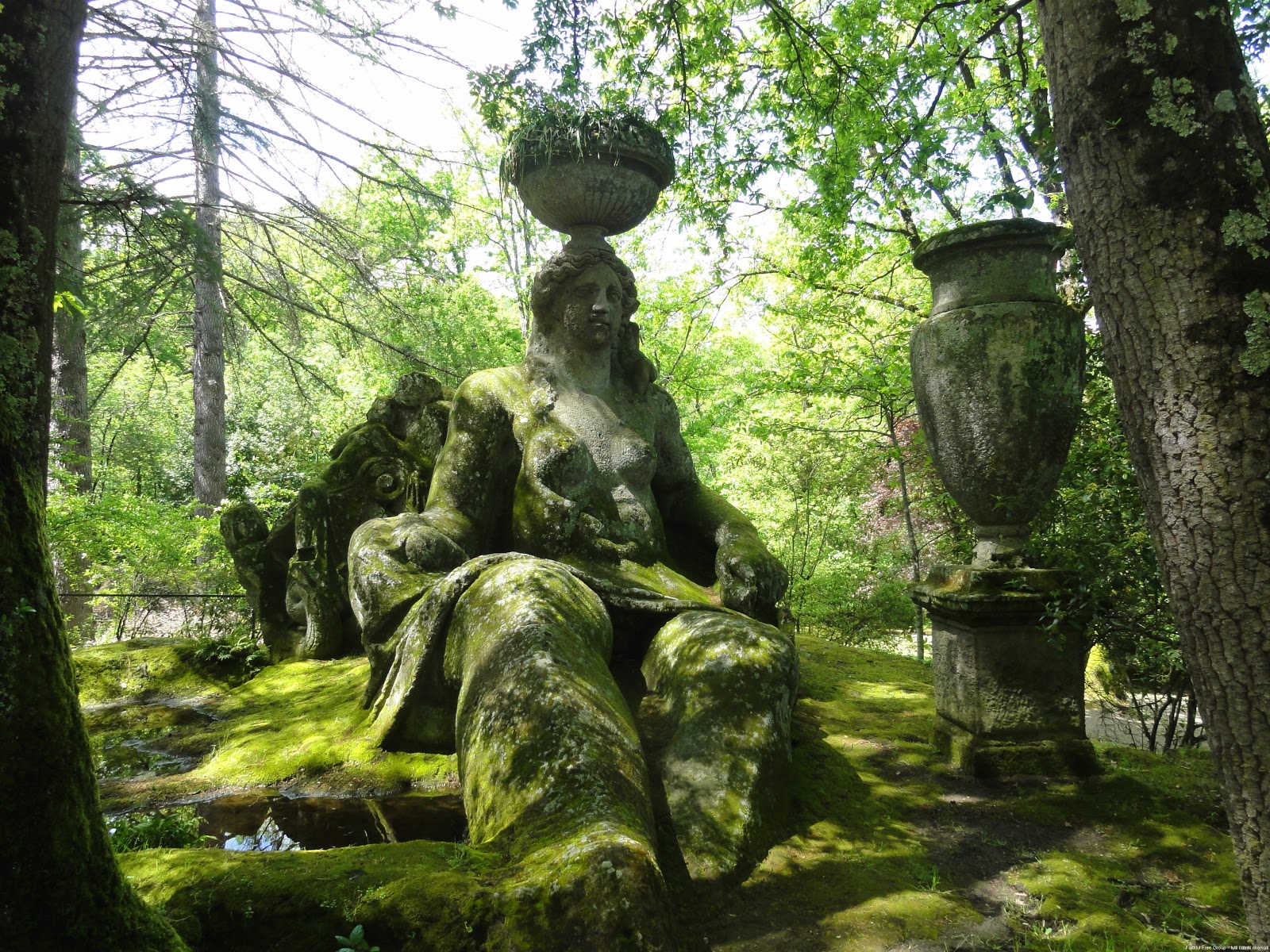
Sacred Grove ~ Gardens of Bomarzo ~ Italy

Magic Fantasy Music - The Ancient Gift
Photography by Bella Kotak

Gardens of Bomarzo
The Sacro Bosco ("Sacred Grove"), colloquially called Park of the Monsters (Parco dei Mostri in Italian), also named Garden of Bomarzo, is a Manieristic monumental complex located in Bomarzo, in the province of Viterbo, in northern Lazio, Italy. About an hour outside of Rome.
The garden was created during the 16th century. The garden is situated in a woods, located in a valley bottom, beneath the castle of Orsini, and populated by sculptures, and small buildings, located among the natural vegetation.
The park's name stems from the many larger-than-life sculptures, some sculpted in the bedrock, which populate this predominantly barren landscape. It is the work of Pier Francesco Orsini, called Vicino, a 16th-century condottiero, and patron of the arts, greatly devoted to his wife Giulia Farnese (not to be confused with her maternal grandmother Giulia Farnese, the mistress of Pope Alexander VI). When Orsini's wife died, he created the gardens to cope with his grief. The design is attributed to Pirro Ligorio, and the sculptures to Simone Moschino.
During the 19th century, and deep into the 20th, the garden became overgrown and neglected, but after the Spanish painter Salvador Dalí made a short movie about the park, and completed a painting actually based on the park in the 1950s, the Bettini family implemented a restoration program which lasted throughout the 1970s, and today the garden, which remains private property, is a major tourist attraction.
The park of Bomarzo was intended not to please, but to astonish, and like many Mannerist works of art, its symbolism is arcane: examples are a large sculpture of one of Hannibal's war elephants, which mangles a Roman legionary, or the statue of Ceres lounging on the bare ground, with a vase of verdure perched on her head.
The many monstrous statues appear to be unconnected to any rational plan, and appear to have been strewn almost randomly about the area, sol per sfogare il Core ("just to set the heart free") as one inscription in the obelisks says.
Allusive verses in Italian by Annibal Caro (the first one is of him, in 1564), Bitussi, and Cristoforo Madruzzo, some of them now eroded, were inscribed beside the sculptures.
The reason for the layout and design of the garden is largely unknown: perhaps they were meant as a foil to the perfect symmetry and layout of the great Renaissance gardens nearby at Villa Farnese, and Villa Lante. Next to a formal exit gate is a tilting watchtower-like casina, the so-called Casa Pendente ("Leaning House").

  • Niki de Saint Phalle was inspired by Bomarzo for her Tarot Garden, Giardino dei Tarocchi.
  • The story behind Bomarzo and the life of Pier Francesco Orsini are the subject of a novel by the Argentinian writer Manuel Mujica Láinez, Bomarzo (1962). Mujica Láinez himself wrote a libretto based on his novel, which was set to music by Alberto Ginastera (1967). The opera Bomarzo premièred in Washington in 1967, since the Argentine government had condemned it as sexually offensive.
  • A reimagined version of the garden is the centerpiece of the novel A Green and Ancient Light, written by Frederic S. Durbin.
Lazio comprises a land area of 17,236 km2 (6,655 sq mi) and it has borders with Tuscany, Umbria, and Marche to the north, Abruzzo and Molise to the east, Campania to the south, and the Tyrrhenian Sea to the west. Tyrrhenian Sea is named for the Tyrrhenian people, identified since the 6th century BCE with the Etruscans of Italy.Its name derives from the Greek name for the Etruscans, who were said to be emigrants from Lydia and led by the prince Tyrrhenus. The Etruscans settled along the coast of modern Tuscany and referred to the water as the "Sea of the Etruscans".
In Etruscan mythology, Tyrrhenus was one of the founders of the Etruscan League of twelve cities, along with his brother Tarchon. Herodotus describes him as the saviour of the Etruscans, because he led them from Lydia to Etruria. His name was given to the Etruscan people by the Greeks. The Romans extended this use to the sea west of Etruria: the Tyrrhenian Sea.
Etruscan religion and mythology were partly incorporated into classical Roman culture, including the Roman pantheon. The Senate adopted key elements of their religion, which were perpetuated by haruspices and noble Roman families who claimed Etruscan descent, long after the general population had forgotten the language. 
Echidna, The Lions And The Fury.

Long after the assimilation of the Etruscans, Seneca the Younger said that the difference between the Romans and the Etruscans was that

Whereas we believe lightning to be released as a result of the collision of clouds, they believe that the clouds collide so as to release lightning: for as they attribute all to deity, they are led to believe not that things have a meaning insofar as they occur, but rather that they occur because they must have a meaning.

More Here


Love and light,
Trace
xoxo