Monday, 6 February 2017

The Paper Unicorn ~ Novel

The Paper Unicorn
The Forgotten Manor 
Miss Felicity Campbell

A butterfly landed
Hearts seeking love ~ Minds independent and strong
The name is derived from an alteration of Aelianus (Latin), Elianus (Latin) or Helianus (Latin), which are ultimately of the Greek 'Helios'. 
A touch replaces words
Two people free of ancient boundaries
Can Clara make sense of the English Manor she inherited?

Love and light,
Trace
xoxo

Sunday, 5 February 2017

Unicorn Foklore

Searching for unicorn myths is a bit like searching for unicorns themselves.  
The unicorn is a legendary creature that has been described since antiquity as a beast with a large, pointed, spiralling horn projecting from its forehead. The unicorn was depicted in ancient seals of the Indus Valley Civilization and was mentioned by the ancient Greeks in accounts of natural history by various writers, including Ctesias, Strabo, Pliny the Younger, and Aelian. The Bible also describes an animal, the re'em (auroch), which some versions translate as a unicorn.
In European folklore, the unicorn is often depicted as a white horse-like or goat-like animal with a long horn and cloven hooves (sometimes a goat's beard). In the Middle Ages and Renaissance, it was commonly described as an extremely wild woodland creature, a symbol of purity and grace, which could only be captured by a virgin. In the encyclopaedias, its horn was said to have the power to render poisoned water potable and to heal sickness. In medieval and Renaissance times, the tusk of the narwhal was sometimes sold as unicorn horn.
The truth is, unlike almost every single other mythical creature, the unicorn does not appear anywhere in any culture's actual mythology.  That is to say, plenty of Greek scholars believed that unicorns existed, but the unicorn itself does not come from Greek mythology.  There are no tales of gods riding unicorns or legends of unicorns fighting monsters.

To put it simply, as far as ancient myths are concerned, there is no such thing as 'unicorn mythology'.
Greek scholars actually believed that this creature was real, noted in the accounts of natural history and that it made its home in India.  At the time, India was a little known distant land that seemed magical and mysterious to the ancient Greeks and Romans.  Fittingly, the unicorn was seen as a mystical and mysterious creature who commanded great respect and power.

This is not unlike the griffin, who many ancient Greeks also believed came from India.  And like the griffin, very few specific tales can be told about the unicorn, despite its popularity around the world.

The strangest part has to be the fact that ancient scholars believed that unicorns were real.  While this is true of other mythical creatures, unicorns are unique in that they aren't from mythology.  For example, ancient people might believe that a Pegasus, the winged horse of Bellerophon, was real because there was a specific myth that spoke of him.  The unicorn, on the other hand, has no such myth, so where does the belief in unicorns come from?
One scholar pointed out an interesting fact about unicorns - they are possibly the only mythical creature that is not based on human fears.  Unicorns are not monsters.  Anytime they are spoken of in ancient texts they are revered and respected.  They are strong, solitary animals who seek to do good for all around them.  Never does a unicorn pose a threat to humans, or any other creature that does not seek first to harm them.
For a creature that came from nowhere, never really existed, and has no real origin, the unicorn has lasted an unbelievable amount of time in the imaginations of the human race.  There really is no parallel.
Source HERE
The Maiden and the Unicorn by Domenichino, 1602.
The unicorn, tamable only by a virgin woman, was well established in medieval lore.

One traditional method of hunting unicorns that involved entrapment by a virgin.
In one of his notebooks, Leonardo da Vinci wrote:

The unicorn, through its intemperance and not knowing how to control itself, for the love it bears to fair maidens forgets its ferocity and wildness; and laying aside all fear it will go up to a seated damsel and go to sleep in her lap, and thus the hunters take it.
A Maiden with a Unicorn by Leonardo da Vinci.
Interpretations of the unicorn myth focus on the medieval lore of beguiled (charm or enchant (someone), often in a deceptive way) lovers. The unicorn also figured in courtly terms: for some 13th-century French authors such as Thibaut of Champagne and Richard de Fournival, the lover is attracted to his lady as the unicorn is to the virgin.

The Throne Chair of Denmark is made of "unicorn horns" – almost certainly narwhal tusks. It is guarded by three life-size silver lions, based on Biblical references, and was a symbol of the absolute monarchy of the Twin Kingdoms. The same material was used for ceremonial cups because the unicorn's horn continued to be believed to neutralise poison.The horn itself and the substance it was made of was called alicorn, and it was believed that the horn holds magical and medicinal properties.
There are famous late Gothic series of seven tapestry hangings The Hunt of the Unicorn.
Another famous set of six tapestries of Dame à la licorne ("Lady with the unicorn") in the Musée de Cluny, Paris, were also woven in the Southern Netherlands before 1500, and show the five senses (the gateways to temptation) and finally Love ("A mon seul desir" the legend reads), with unicorns featured in each piece. Facsimiles of these unicorn tapestries are currently being woven for permanent display in Stirling Castle, Scotland, to take the place of a set recorded in the castle in a 16th-century inventory.
In heraldry, the unicorn is best known as the symbol of Scotland. The unicorn was chosen because it was seen as a proud and haughty beast which would rather die than be captured, just as Scots would fight to remain sovereign and unconquered. Two unicorns supported the royal arms of the King of Scots, and since the 1707 union of England and Scotland, the royal arms of the United Kingdom have been supported by a unicorn along with an English lion. Two versions of the royal arms exist: that used in Scotland gives more emphasis to the Scottish elements, placing the unicorn on the left and giving it a crown, whereas the version used in England and elsewhere gives the English elements more prominence.

My interest has grown in the unicorn and this mystical creature has inspired a new novel called 'The Paper Unicorn'. I'm really excited about this story, it is quite different to my others. However, I must complete book two for publishing this year 'A Carpet of Purple Flowers' series and then I'm free to play with this idea. Can't wait. :o) Meanwhile, in my spare time I'm compiling a mood book so I don't lose track of the tale. I'll share pieces that I create here on the blog.
Love and light,
Trace
xoxo

Tuesday, 31 January 2017

Laetitia Miéral ~ Artist


DOLLHOUSES - MAISONS DE POUPEES
I've always loved fairy tales, stories, magic, and dreams. Paper is a never ending inspiration and joy. I like to get lost in nature, discovering haunted castles, and enjoying very early morning walks. These past years my work has been on display in museums, castles, galleries. Take a glimpse  HERE.  
~ Laetitia Miéral, Lyon, France. (Artist)
I didn't study in any regular art school I taught myself everything I know, but I studied Art History at university, though I probably forgot quite a bunch now. 
Love and light,
Trace
xoxo

Monday, 30 January 2017

Dawn Mist by Robert Charity


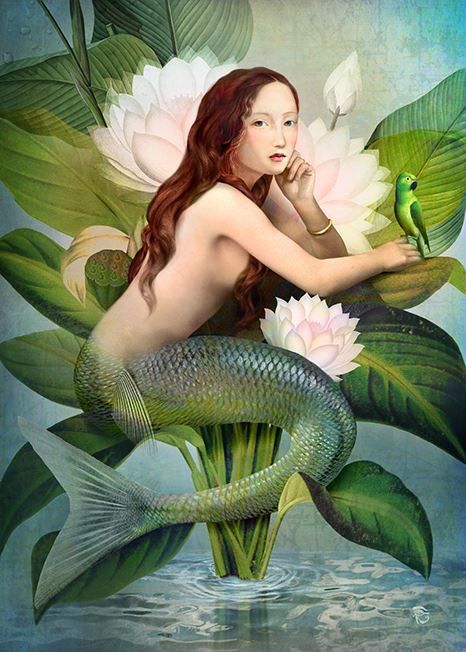
Mermaid Lore - Christian Schloe Art

Mermaids appear in the folklore of many cultures worldwide, including the Near East, Europe, Africa and Asia. The first stories appeared in ancient Assyria, in which the goddess Atargatis transformed herself into a mermaid out of shame for accidentally killing her human lover. Mermaids are sometimes associated with perilous events such as floods, storms, shipwrecks and drownings. In other folk traditions (or sometimes within the same tradition), they can be benevolent or beneficent, bestowing boons or falling in love with humans.
Atargatis was the chief goddess of northern Syria in Classical Antiquity. Ctesias also used the name Derceto for her, and the Romans called her Dea Syriae ("Syrian goddess"). Primarily she was a goddess of fertility, but, as the baalat ("mistress") of her city and people, she was also responsible for their protection and well-being. Her chief sanctuary was at Hierapolis, modern Manbij, northeast of Aleppo, Syria.
As Ataratheh, doves and fish were considered sacred to her: doves as an emblem of the Love-Goddess, and fish as symbolic of the fertility and life of the waters.
‘Atar‘atheh is seen as a continuation of Bronze Age goddesses. At Ugarit, cuneiform tablets attest the three great Canaanite goddesses 'Aṭirat (Asherah) — described as a fecund "Lady Goddess of the Sea" (rabbatu at̪iratu yammi) — ‘Anat (Anat, Anath), and ‘Ațtart (Astarte), who shared many traits with each other and may have been worshiped in conjunction or separately during 1500 years of cultural history.

From Syria her worship extended to Greece and to the furthest West. Lucian and Apuleius give descriptions of the beggar-priests who went round the great cities with an image of the goddess on an ass and collected money. The wide extension of the cult is attributable largely to Syrian merchants; thus we find traces of it in the great seaport towns; at Delos especially numerous inscriptions have been found bearing witness to her importance. The island of Delos near Mykonos, near the centre of the Cyclades archipelago, is one of the most important mythological, historical and archaeological sites in Greece.

Delos had a position as a holy sanctuary for a millennium before Olympian Greek mythology made it the birthplace of Apollo and Artemis. From its Sacred Harbour, the horizon shows the two conical mounds that have identified landscapes sacred to a goddess in other sites: one, retaining its Pre-Greek name Mount Kynthos, is crowned with a sanctuary of Zeus.
Leto, a daughter of the Titans Coeus and Phoebe, the sister of Asteria, searching for a birthing place for Artemis and Apollo, addressed the island:

Delos, if you would be willing to be the abode of my son Phoebus Apollo and make him a rich temple –; for no other will touch you, as you will find: and I think you will never be rich in oxen and sheep, nor bear vintage nor yet produce plants abundantly. But if you have the temple of far-shooting Apollo, all men will bring you hecatombs and gather here, and incessant savour of rich sacrifice will always arise, and you will feed those who dwell in you from the hand of strangers; for truly your own soil is not rich.

— Homeric Hymn to Delian Apollo 51–60
The male equivalent of the mermaid is the merman, also a familiar figure in folklore and heraldry. Although traditions about and sightings of mermen are less common than those of mermaids, they are generally assumed to co-exist with their female counterparts.
Some of the attributes of mermaids may have been influenced by the Sirens of Greek mythology.
Sirens were said to be dangerous creatures, who lured nearby sailors with their enchanting music and voices to shipwreck on the rocky coast of their island. Roman poets placed them on some small islands called Sirenum scopuli. In some later, rationalised traditions, the literal geography of the "flowery" island of Anthemoessa, or Anthemusa, is fixed: sometimes on Cape Pelorum and at others in the islands known as the Sirenuse, near Paestum, or in Capreae. All such locations were surrounded by cliffs and rocks.
Although a Sophocles fragment makes Phorcys their father, when Sirens are named, they are usually as daughters of the river god Achelous, with Terpsichore, Melpomene, Sterope, or Chthon (the Earth). In Euripides' play, Helen (167), Helen in her anguish calls upon "Winged maidens, daughters of the Earth." Although they lured mariners, the Greeks portrayed the Sirens in their "meadow starred with flowers" and not as sea deities. Roman writers linked the Sirens more closely to the sea, as daughters of Phorcys. Sirens are found in many Greek stories, notably in Homer's Odyssey.
"It is strange and beautiful that Homer should make the Sirens appeal to the spirit, not to the flesh."
"They are mantic creatures like the Sphinx with whom they have much in common, knowing both the past and the future",  Jane Ellen Harrison observed. "Their song takes effect at midday, in a windless calm."
Sirens were believed to combine women and birds in various ways. In early Greek art, Sirens were represented as birds with large women's heads, bird feathers and scaly feet. Later, they were represented as female figures with the legs of birds, with or without wings, playing a variety of musical instruments, especially harps. The 10th-century Byzantine encyclopaedia Suda says that from their chests up Sirens had the form of sparrows, below they were women, or, alternatively, that they were little birds with women's faces. Birds were chosen because of their beautiful voices. Later Sirens were sometimes depicted as beautiful women, whose bodies, not only their voices, are seductive.
By the fourth century, when pagan beliefs were overtaken by Christianity, belief in literal sirens was discouraged.
The theme of perilous mythical female creatures seeking to seduce men with their beautiful singing is repeated in the Danish ballad known as "Elvehøj", in which the singers are Elves.
The ballad is in the first person. The narrator, an attractive young man, falls asleep beside an elf-mound (or elvehøj). Some women (usually elf-maidens) then attempt to woo the narrator, singing so beautifully that the natural world responds (the streams stop flowing, fish dance for joy, etc., depending on the variant). The narrator, however, resists their blandishments, grasping his sword (usually in silence). The man is most often rescued by the crowing of a cock waking him, though in the Danish A-version, from the mid-sixteenth-century Jens Billes visebog (known to Grundtvig as 'Sten Bille’s Haandskrift'), he is saved by the advice of his sister who, previously enchanted, is one of the elf-maidens. The ballad usually ends with moralising advice to the listeners.
Love and light,
Trace
xoxo