Showing posts with label mermaid. Show all posts

Friday, 10 February 2017

Illustrations of Undine ~ Arthur Rackham ~ August Gaber - Adalbert Mueller

Art collaboration between Adalbert Mueller and August Gaber. 
Undine is a fairy-tale novella (Erzählung) by Friedrich de la Motte Fouqué in which Undine, a water spirit, marries a knight named Huldebrand in order to gain a soul. It is an early German romance.
Illustration of Undine from 1909 ~ Arthur Rackham
Art collaboration between Adalbert Mueller and August Gaber 
The story is descended from Melusine, the French folktale of a water-sprite who marries a knight on condition that he shall never see her on Saturdays when she resumes her mermaid shape. It was also inspired by works by the occultist Paracelsus.
Illustration of Undine from 1909 ~ Arthur Rackham
Art collaboration between Adalbert Mueller and August Gaber 
An unabridged English translation of the story by William Leonard Courtney and illustrated by Arthur Rackham was published in 1909. George Macdonald thought Undine "the most beautiful" of all fairy stories, while Lafcadio Hearn referred to Undine as a "fine German story" in his essay "The Value of the Supernatural in Fiction".
Illustration of Undine from 1909 ~ Arthur Rackham
Art collaboration between Adalbert Mueller and August Gaber 
In the 1830s, the novella was translated into Russian dactylic hexameter verse by the Romantic poet Vasily Zhukovsky. This verse translation became a classic in its own right and later provided the basis for the libretto to Tchaikovsky's operatic adaptation. The novella has since inspired numerous similar adaptions in various genres and traditions.
Illustration of Undine from 1909 ~ Arthur Rackham
Art collaboration between Adalbert Mueller and August Gaber 
Love and light,
Trace
xoxo

Monday, 30 January 2017

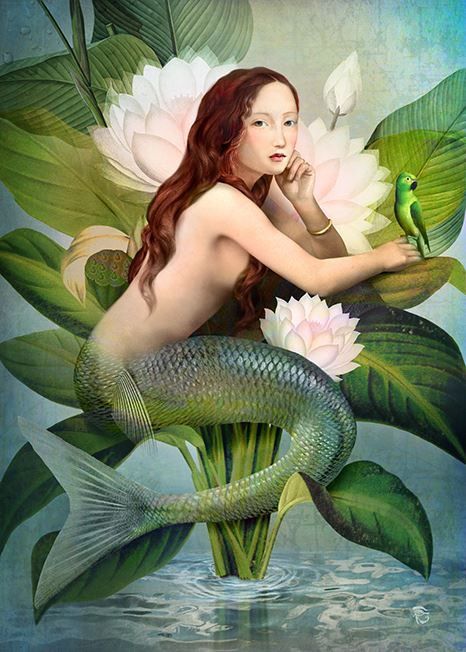
Mermaid Lore - Christian Schloe Art

Mermaids appear in the folklore of many cultures worldwide, including the Near East, Europe, Africa and Asia. The first stories appeared in ancient Assyria, in which the goddess Atargatis transformed herself into a mermaid out of shame for accidentally killing her human lover. Mermaids are sometimes associated with perilous events such as floods, storms, shipwrecks and drownings. In other folk traditions (or sometimes within the same tradition), they can be benevolent or beneficent, bestowing boons or falling in love with humans.
Atargatis was the chief goddess of northern Syria in Classical Antiquity. Ctesias also used the name Derceto for her, and the Romans called her Dea Syriae ("Syrian goddess"). Primarily she was a goddess of fertility, but, as the baalat ("mistress") of her city and people, she was also responsible for their protection and well-being. Her chief sanctuary was at Hierapolis, modern Manbij, northeast of Aleppo, Syria.
As Ataratheh, doves and fish were considered sacred to her: doves as an emblem of the Love-Goddess, and fish as symbolic of the fertility and life of the waters.
‘Atar‘atheh is seen as a continuation of Bronze Age goddesses. At Ugarit, cuneiform tablets attest the three great Canaanite goddesses 'Aṭirat (Asherah) — described as a fecund "Lady Goddess of the Sea" (rabbatu at̪iratu yammi) — ‘Anat (Anat, Anath), and ‘Ațtart (Astarte), who shared many traits with each other and may have been worshiped in conjunction or separately during 1500 years of cultural history.

From Syria her worship extended to Greece and to the furthest West. Lucian and Apuleius give descriptions of the beggar-priests who went round the great cities with an image of the goddess on an ass and collected money. The wide extension of the cult is attributable largely to Syrian merchants; thus we find traces of it in the great seaport towns; at Delos especially numerous inscriptions have been found bearing witness to her importance. The island of Delos near Mykonos, near the centre of the Cyclades archipelago, is one of the most important mythological, historical and archaeological sites in Greece.

Delos had a position as a holy sanctuary for a millennium before Olympian Greek mythology made it the birthplace of Apollo and Artemis. From its Sacred Harbour, the horizon shows the two conical mounds that have identified landscapes sacred to a goddess in other sites: one, retaining its Pre-Greek name Mount Kynthos, is crowned with a sanctuary of Zeus.
Leto, a daughter of the Titans Coeus and Phoebe, the sister of Asteria, searching for a birthing place for Artemis and Apollo, addressed the island:

Delos, if you would be willing to be the abode of my son Phoebus Apollo and make him a rich temple –; for no other will touch you, as you will find: and I think you will never be rich in oxen and sheep, nor bear vintage nor yet produce plants abundantly. But if you have the temple of far-shooting Apollo, all men will bring you hecatombs and gather here, and incessant savour of rich sacrifice will always arise, and you will feed those who dwell in you from the hand of strangers; for truly your own soil is not rich.

— Homeric Hymn to Delian Apollo 51–60
The male equivalent of the mermaid is the merman, also a familiar figure in folklore and heraldry. Although traditions about and sightings of mermen are less common than those of mermaids, they are generally assumed to co-exist with their female counterparts.
Some of the attributes of mermaids may have been influenced by the Sirens of Greek mythology.
Sirens were said to be dangerous creatures, who lured nearby sailors with their enchanting music and voices to shipwreck on the rocky coast of their island. Roman poets placed them on some small islands called Sirenum scopuli. In some later, rationalised traditions, the literal geography of the "flowery" island of Anthemoessa, or Anthemusa, is fixed: sometimes on Cape Pelorum and at others in the islands known as the Sirenuse, near Paestum, or in Capreae. All such locations were surrounded by cliffs and rocks.
Although a Sophocles fragment makes Phorcys their father, when Sirens are named, they are usually as daughters of the river god Achelous, with Terpsichore, Melpomene, Sterope, or Chthon (the Earth). In Euripides' play, Helen (167), Helen in her anguish calls upon "Winged maidens, daughters of the Earth." Although they lured mariners, the Greeks portrayed the Sirens in their "meadow starred with flowers" and not as sea deities. Roman writers linked the Sirens more closely to the sea, as daughters of Phorcys. Sirens are found in many Greek stories, notably in Homer's Odyssey.
"It is strange and beautiful that Homer should make the Sirens appeal to the spirit, not to the flesh."
"They are mantic creatures like the Sphinx with whom they have much in common, knowing both the past and the future",  Jane Ellen Harrison observed. "Their song takes effect at midday, in a windless calm."
Sirens were believed to combine women and birds in various ways. In early Greek art, Sirens were represented as birds with large women's heads, bird feathers and scaly feet. Later, they were represented as female figures with the legs of birds, with or without wings, playing a variety of musical instruments, especially harps. The 10th-century Byzantine encyclopaedia Suda says that from their chests up Sirens had the form of sparrows, below they were women, or, alternatively, that they were little birds with women's faces. Birds were chosen because of their beautiful voices. Later Sirens were sometimes depicted as beautiful women, whose bodies, not only their voices, are seductive.
By the fourth century, when pagan beliefs were overtaken by Christianity, belief in literal sirens was discouraged.
The theme of perilous mythical female creatures seeking to seduce men with their beautiful singing is repeated in the Danish ballad known as "Elvehøj", in which the singers are Elves.
The ballad is in the first person. The narrator, an attractive young man, falls asleep beside an elf-mound (or elvehøj). Some women (usually elf-maidens) then attempt to woo the narrator, singing so beautifully that the natural world responds (the streams stop flowing, fish dance for joy, etc., depending on the variant). The narrator, however, resists their blandishments, grasping his sword (usually in silence). The man is most often rescued by the crowing of a cock waking him, though in the Danish A-version, from the mid-sixteenth-century Jens Billes visebog (known to Grundtvig as 'Sten Bille’s Haandskrift'), he is saved by the advice of his sister who, previously enchanted, is one of the elf-maidens. The ballad usually ends with moralising advice to the listeners.
Love and light,
Trace
xoxo

Tuesday, 27 August 2013

The Mermaid of Zennor

Hi everyone!
I am thinking of submitting to Art Doll Quarterly - mermaid challenge
My choice of doll story would be:

The Mermaid of Zennor

 Zennor rd was the name of the street where my mother,Christine was brought up.
I lived there too,as a baby before she sold up to live on a barge!!
So it wasn't difficult to find a mermaid lore that resonated with a part of my memory lane.
If you do not know the story let me enlighten you - 


Long ago, a beautiful and richly-dressed woman occasionally attended services at St. Senara's Church in Zennor, and sometimes at Morvah. The parishioners were enchanted by her beauty and her voice, for her singing was sweeter than all the rest. She appeared infrequently for scores of years, but never seemed to age, and nobody knew whence she came, although they watched her from the summit of Tregarthen Hill. After many years, the mysterious woman became interested in a young man named Mathey Trewella, "the best singer in the parish." One day he followed her home, and disappeared; neither was ever seen again in Zennor Church.
The villagers wondered what had become of the two, until one Sunday a ship cast anchor about a mile from Pendour Cove. Soon after, a mermaid appeared, and asked that the anchor be raised, as one of its flukes was resting on her door, and she was unable to reach her children. The sailors obliged, and quickly set sail, believing the mermaid to be an ill omen. But when the villagers heard of this, they concluded that the mermaid was the same lady who had long visited their church, and that she had enticed Mathey Trewella to come and live with her.
The parishioners at St. Senara's commemorated the story by having one end of a bench carved in the shape of a mermaid. A shorter account of the legend was related to Bottrell on a subsequent visit to Cornwall. The mermaid had come to church every Sunday to hear the choir sing, and her own voice was so sweet that she enticed Mathey Trewella, son of the churchwarden, to come away with her; neither was seen again on dry land. The famed "mermaid chair" was the same bench on which the mermaid had sat and sung, opposite Trewella in the singing loft.
 The local legend : a mermaid in Zennor. Matthew Trewella was a good-looking young man with a nice voice. Each evening Matthew would sing the closing hymn at the church in Zennor. A mermaid living in neighbouring Pendour Cove was enchanted by the music. She dressed in a long dress to hide her long tail and walked (how?) to the church. She was amazed by Matthew's singing, and listened a little bit before slipping away to return to the sea. She came every day staying longer and longer. It was on one of these visits that her gaze met Matthew's, and they fell in love. However, the mermaid knew she had to go back to the sea or die. As she prepared to leave, Matthew said "Please do not leave, who are you, where are you from?". The mermaid told him her problem. Matthew was so love-struck that he swore he would follow her wherever she went. Matthew carried her to the cove, all the while his mother crying and pleading with him to stay. She reminded him that mermaids have no souls and by joining them, he too would lose his. He was so in love with the mermaid that it didn't matter, he followed her beneath the waves, never to be seen again. It is said that if you sit above Pendour Cove at sunset on a fine day you can hear Mathew singing above the waves.

 Here is an addition to the local tale :

Several years after Matthew Trewella's disappearance  a mermaid rose from the sea bed to complain with the captain of a ship lying off Pendower Cove. His anchor was laying across her door under the sea and prevented her from going home to her husband, Matthew Trewella and their children. The captian gave orders, the anchor was drawn up, and upon their return to Zennor the captain spread the word of Matthew's fate. The villagers, in an effort to warn other young men of Matthew's fate (remember by taking to the sea he gave up his soul,) had the image of the mermaid carved in holy-oak in the church.

In another version of this part of the tale, it is Matthew who asks the sailors to move anchor as his wife is trapped in the house and they don't want to be late for church.  This is of course probably not the version circulated by the church. It probably comes to us from the belief that everything on land had a under sea counterpart; Sea cats and dogs, and under sea churches, etc.
The Mermaid Chair in St. Senara's Church (2005), Cornwall, England
Pendour Cove. Beautiful rugged cove where the mermaid of Zennor lived.
Parish Church of St Senara. Inside the church is the now famous (thanks to the book of the same name) Mermaid Chair. The "chair" is actually two medieval bench-ends (over 600 years old) made into a seat. The carving on one end depicts a mermaid holding a comb and mirror.


A beautiful tales :) 

Reaching Zennor at the end of your walk you will find a wild, remote but fascinating settlement with a history going back over 4000 years. The name comes from Saint Senara , a Breton Saint whose original chapel was said to be on the land now occupied by the church.  

Its most famous resident DH Lawrence talked of the village "nestling under high shaggy moor hills and a big sweep of lovely seas lovelier even than the Mediterranean" His summary being "It is the best place I have been in – I think".

Today don’t miss the unique Wayside Museum at Zennor which got its name after its first proprietor “Colonel" Freddie Hirst" started displaying the artefacts by the side of the road. Said to be the oldest privately owned museum in the UK the former mill house now houses over 5000 items of Cornish life and culture in its  15 rooms. 

The 12C Church of St Senara at Zennor is also worth visiting – it can be a sobering spot with its memorials to John Davey claimed on this coast to be the last Cornish Speaker, to those lost at sea and those lost in the mines. Wander round the graveyard to get an idea of how many unlucky sailors ended up under the ground here far away from their homes. 

For those wanting an evening walk you can head  up rocky Zennor Hill behind the village for great views of the coastline and to seek the ancient stones at Zennor Quoit.  If that’s too industrious just outside the village look for Giants Rock the seat of the legendary giant of Carn Galva, the striking peak along the coast from the village. Would be witches need to climb the rock nine times at midnight to gain their magical powers. 

Zennor Quoit


If you know of any mermaid stories please leave a message with details below.

Love and light
Trace
xoxo