Las Pozas (“the Pools”) is a sculpture garden built by Edward James, the eccentric English poet and artist, and patron of the Surrealist movement. More than 2,000 feet above sea level, in a tropical rain forest in the mountains of Mexico, it includes more than 80 acres of natural waterfalls and pools interlaced with towering Surrealist sculptures in concrete.
Las Pozas is near the village of Xilitla, San Luis Potosí, a seven-hour drive north of Mexico City. In the early 1940s, James went to Los Angeles, and then decided that he “wanted a Garden of Eden set up ~ saw that Mexico was far more romantic” and had “far more room than there is in crowded Southern California.” In Cuernavaca, he hired Plutarco Gastelum, then a young manager of a telegraph office, as a guide. The two found Xilitla in November 1945.
In Xilitla, Plutarco married a local woman and had four children. They all lived with “Uncle Edward”, as the children called James, in a house Plutarco had built, a mock-Gothic cement castle, now a hotel – La Posada El Castillo.
Between 1949 and 1984, James built thirty-six concrete follies – palaces, temples and pagodas, including the House on Three Floors which has Five or Four or Six, the House with a Roof like a Whale, and the Staircase to Heaven. There were also plantings and beds full of tropical plants, including orchids – there were, apparently, 29,000 at Las Pozas at one time – and a variety of small casas (homes), niches, and pens that held exotic birds and wild animals from the world over. Massive sculptures up to four stories tall punctuate the site. The many trails throughout the garden site are composed of steps, ramps, bridges and narrow, winding walkways that traverse the valley walls. Construction of Las Pozas cost more than $5 million. To pay for it, James sold his collection of Surrealist art at auction.
The brighter area is to the left of the back garden.
I should be fast zzzzzz but needed to see if the sky got darker since 9.45pm. It's like time has paused.
Straight ahead view.
View to the right of my garden.
Every detail is still seen on the houses, fence, grass, etc, normally I can't see anything from the back door at evening time, and my camera would only pick up pitch black.
“Skeleton Flowers” become transparent when it rains.
The white skeleton flower is somewhat rare, growing in only three locations in the world: the cool, mountainside wetlands of Japan, China, and the Appalachian area of the US.
Diphylleia grayi is a flowering plant that is sometimes called Umbrella Leaf, but its other name, Skeleton Flower, is much more descriptive. When it rains, the otherwise pure white flowers of diphylleia grayi turn spectacularly translucent.
When not in bloom, the plant is quite plain.
As soon as the flowers dry out, they return to their normal white coloration.
The Sacro Bosco ("Sacred Grove"), colloquially called Park of the Monsters (Parco dei Mostri in Italian), also named Garden of Bomarzo, is a Manieristic monumental complex located in Bomarzo, in the province of Viterbo, in northern Lazio, Italy. About an hour outside of Rome.
The garden was created during the 16th century. The garden is situated in a woods, located in a valley bottom, beneath the castle of Orsini, and populated by sculptures, and small buildings, located among the natural vegetation.
The park's name stems from the many larger-than-life sculptures, some sculpted in the bedrock, which populate this predominantly barren landscape. It is the work of Pier Francesco Orsini, called Vicino, a 16th-century condottiero, and patron of the arts, greatly devoted to his wife Giulia Farnese (not to be confused with her maternal grandmother Giulia Farnese, the mistress of Pope Alexander VI). When Orsini's wife died, he created the gardens to cope with his grief. The design is attributed to Pirro Ligorio, and the sculptures to Simone Moschino.
During the 19th century, and deep into the 20th, the garden became overgrown and neglected, but after the Spanish painter Salvador Dalí made a short movie about the park, and completed a painting actually based on the park in the 1950s, the Bettini family implemented a restoration program which lasted throughout the 1970s, and today the garden, which remains private property, is a major tourist attraction.
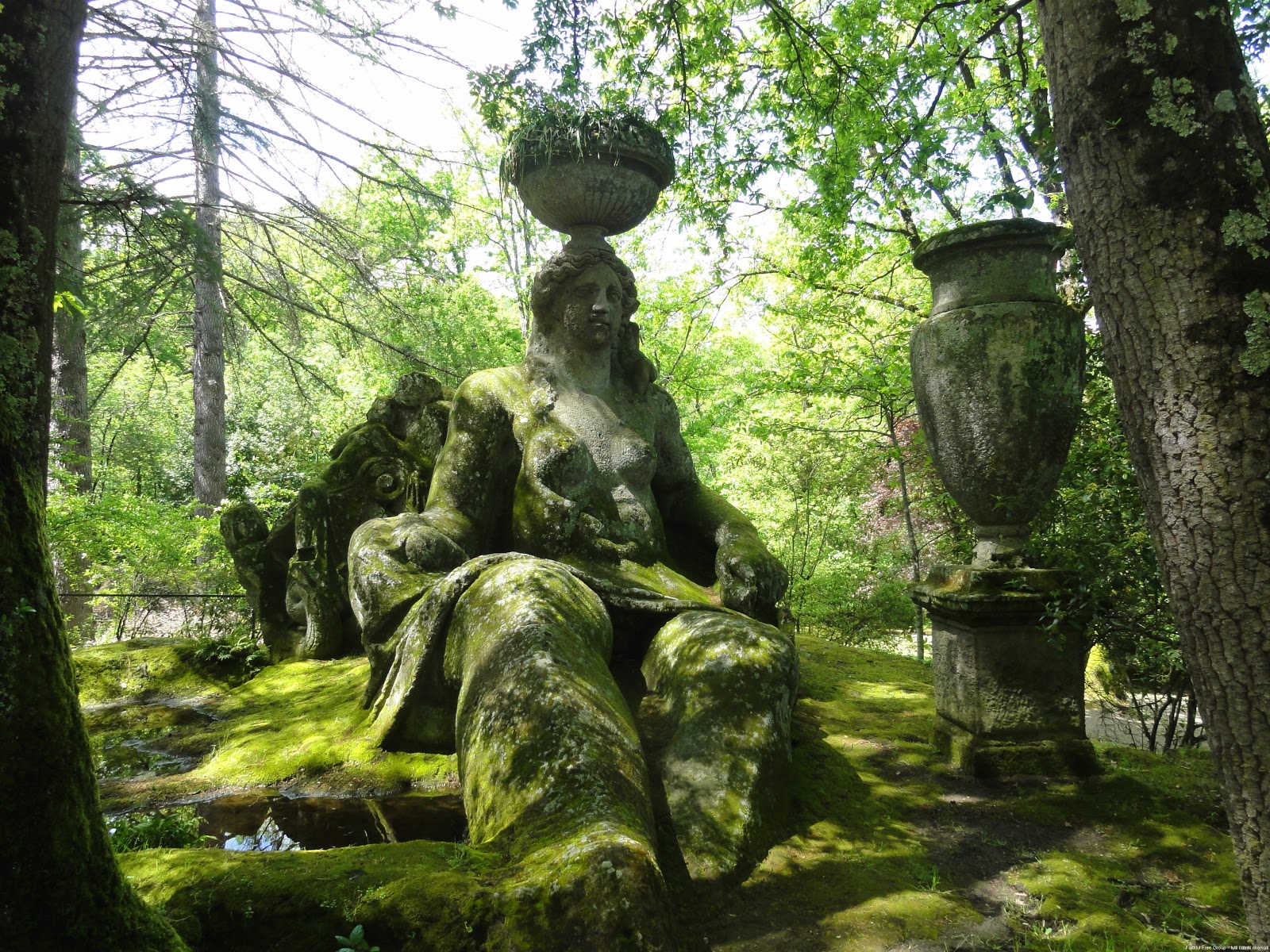
The park of Bomarzo was intended not to please, but to astonish, and like many Mannerist works of art, its symbolism is arcane: examples are a large sculpture of one of Hannibal's war elephants, which mangles a Roman legionary, or the statue of Ceres lounging on the bare ground, with a vase of verdure perched on her head.
The many monstrous statues appear to be unconnected to any rational plan, and appear to have been strewn almost randomly about the area, sol per sfogare il Core ("just to set the heart free") as one inscription in the obelisks says.
Allusive verses in Italian by Annibal Caro (the first one is of him, in 1564), Bitussi, and Cristoforo Madruzzo, some of them now eroded, were inscribed beside the sculptures.
The reason for the layout and design of the garden is largely unknown: perhaps they were meant as a foil to the perfect symmetry and layout of the great Renaissance gardens nearby at Villa Farnese, and Villa Lante. Next to a formal exit gate is a tilting watchtower-like casina, the so-called Casa Pendente ("Leaning House").
Niki de Saint Phalle was inspired by Bomarzo for her Tarot Garden, Giardino dei Tarocchi.
The story behind Bomarzo and the life of Pier Francesco Orsini are the subject of a novel by the Argentinian writer Manuel Mujica Láinez, Bomarzo (1962). Mujica Láinez himself wrote a libretto based on his novel, which was set to music by Alberto Ginastera (1967). The opera Bomarzo premièred in Washington in 1967, since the Argentine government had condemned it as sexually offensive.
A reimagined version of the garden is the centerpiece of the novel A Green and Ancient Light, written by Frederic S. Durbin.
Lazio comprises a land area of 17,236 km2 (6,655 sq mi) and it has borders with Tuscany, Umbria, and Marche to the north, Abruzzo and Molise to the east, Campania to the south, and the Tyrrhenian Sea to the west. Tyrrhenian Sea is named for the Tyrrhenian people, identified since the 6th century BCE with the Etruscans of Italy.Its name derives from the Greek name for the Etruscans, who were said to be emigrants from Lydia and led by the prince Tyrrhenus. The Etruscans settled along the coast of modern Tuscany and referred to the water as the "Sea of the Etruscans".
In Etruscan mythology, Tyrrhenus was one of the founders of the Etruscan League of twelve cities, along with his brother Tarchon. Herodotus describes him as the saviour of the Etruscans, because he led them from Lydia to Etruria. His name was given to the Etruscan people by the Greeks. The Romans extended this use to the sea west of Etruria: the Tyrrhenian Sea.
Etruscan religion and mythology were partly incorporated into classical Roman culture, including the Roman pantheon. The Senate adopted key elements of their religion, which were perpetuated by haruspices and noble Roman families who claimed Etruscan descent, long after the general population had forgotten the language.
Echidna, The Lions And The Fury.
Long after the assimilation of the Etruscans, Seneca the Younger said that the difference between the Romans and the Etruscans was that
Whereas we believe lightning to be released as a result of the collision of clouds, they believe that the clouds collide so as to release lightning: for as they attribute all to deity, they are led to believe not that things have a meaning insofar as they occur, but rather that they occur because they must have a meaning.
I love to sit in this half of the garden in the summer. The flowers disappear, and the tree fills with lush green leaves until ready to bloom a second time. At the end of the month, I'll be visiting the Trossachs. Once I return, I'll be writing away under this beauty! Not long now.